Midway's 1969 Sea Raider arcade repairs
To write is to illuminate. The writer must gild the edges of the mundane with his words to evoke something within the reader. But to paraphrase a fellow pinball writer I greatly respect: There's only so much you can write about changing a pinball coil. What then? Coin operated amusement devices are a means to an end. In the collecting world, the means are often confused with the end. The machines themselves are MacGuffins, a device to advance the plot. So to loop back to the Sea Raider(s) what do you do when you have a totally boring road trip and boring repairs? You try to fluff it up somewhat.
I like arcade games of that era. They have a certain naive charm. Over the years I've accumulated a few. Space Gun, Road Runner, Wild Cycle, S.A.M.I. and now Sea Raider.
Yes, the game play is simplistic and repetitive but I just love the colors, the sounds, the black lights the cardboard scenery.
A miniature Potemkin village, an allegory of the world we live in. Cardboard facades, flashy lights and mirrors. All to entertain and liberate you from your coins.

On a personal level, Sea Raider holds a special space in my memory. It was the first arcade game I ever got working. I wouldn't say fixed, but it worked and played- ish. I was 18 and had little repair experience then. I eventually sold the game around 2007 or 2008. I've missed it ever since.
A bit of condensed semi reliable arcade history:
Post WW2 was a time of innovation in the United States. The coin-op industry was no different: Flippers, bowlers, increasingly complex one ball games followed by bingo machines, driving games, shuffle alleys, etc. But by the 1960's what was new and novel was now stale and formulaic. The industry needed something new.
On the other side of the world, by the 1960's, the post war recovery of Japan was creating huge innovation, same with the emergent Japanese coin-op industry. The US coin-op industry took notice of the Japanese innovation boom and copied the games for the western market.
I think Kasco's Indy 500 (1969) produced under license as Chicago Coin's Speedway is the best known of these games. SEGA's Periscope led to Midway's Sea Raider, the first of a new era of submarine games (Sea Devil, Submarine, Sea Wolf). Curiously, Sea Raider cabinet art bares a remarkable resemblance to Bally's 1946 Undersea Raider.


The Japanese influence reinvigorated the North American EM coin-operated industry. These new games had cool effects and electronic sounds. But it was to be short lived: By 1972, the first video games appeared on the market and the rapidly developing solid state and computer technology meant that the days of electro-mechanical technology were numbered.
For more in depth coin operated amusement history, I recommend this super long article about the US and Japanese coin operated industry. It's way more detailed and well worth the read.
Sea Raider repairs:
Sea Raiders is a super basic game to work on. I think it's a good game to work on as an introduction to electro-mechanical arcade repair.
The best games to find are warehouse finds. From experience, the more previous owners between you and the last Coin Operator that put the game into storage, the more questionable repairs and "restorations" the games suffer from.
I was fortunate to find these games in an untouched state (other than the coin door lock that was drilled out). I honestly didn't think there were any warehouse find games like these left in the Republic of Quebecistan. They still have the period correct Dime and Quarter coin mechanisms, the coin boxes with the tops and even the back door keys. The cabinets are solid and have minimal moisture damage.


I have two examples of the same title in similar condition, both operated the same way, stored the same way, even the serial numbers make them less than 10 games apart off the assembly line, so needless to say the repairs were very similar on both games.
The last thing you should do when you first acquire your warehouse find is to plug it in. First: inspect the game. Inspect everything top to bottom, front to back. Start with the plug (stecker), the power cord, the switch, the fuse clips, the fuses, the transformer, all the wiring inside the game. Then everything else: connectors, relays, steppers, motors, coils, etc.
Look for any and all damage, corrosion, missing parts, loose parts. Clean out the cabinet and set aside any parts you may find at the bottom of the cabinet. These parts tell machine's story and can point you towards problems with the game. Then, you have a good overview of the repairs required.


Gearmotors:
Sea Raider uses multiple Multi-Products gearmotors. They have felt pads that should be periodically oiled. An oil hole is provided.

Stepper Units:
Make sure the ratchet gear and shaft spins freely. Free up the drive arm... and the reset arm. Check all the pivot points. Clean the coil stops, coil sleeves and plungers. Burnish the contact pads. Check the wiper assembly. Lube up metal on metal moving parts. There are different schools of thought when it comes to choice of lubricants... pick your libation of choice.


To clean the contact discs. I use a green Scotch-brite pad (the 3M ones, not the knockoffs) with pure Isopropyl and shop rags. Then I use an electrician's eraser or a fiber pen to clean the conductive pads. Then I use a nylon bristle brush to really clean between the pads. Then I inspect for burnt micarta (phenolic and fiber material) between the pads. Remove the burnt micarta with dentists tools or a hobby knife. To finish it off, I buff the micarta with Novus 2 to take off the swirl marks, making sure to remove all the clay residue from Novus.
Before:

After:

On the printed circuit discs for the torpedo course arm disc and the ship target panel disc I use shop rags, Isopropyl and Novus 2 to avoid damaging the traces and pads. Again I check for burnt material. The ship target panel disc is notorious for burning between the pads at the point where the boat reverses.

Selector unit:
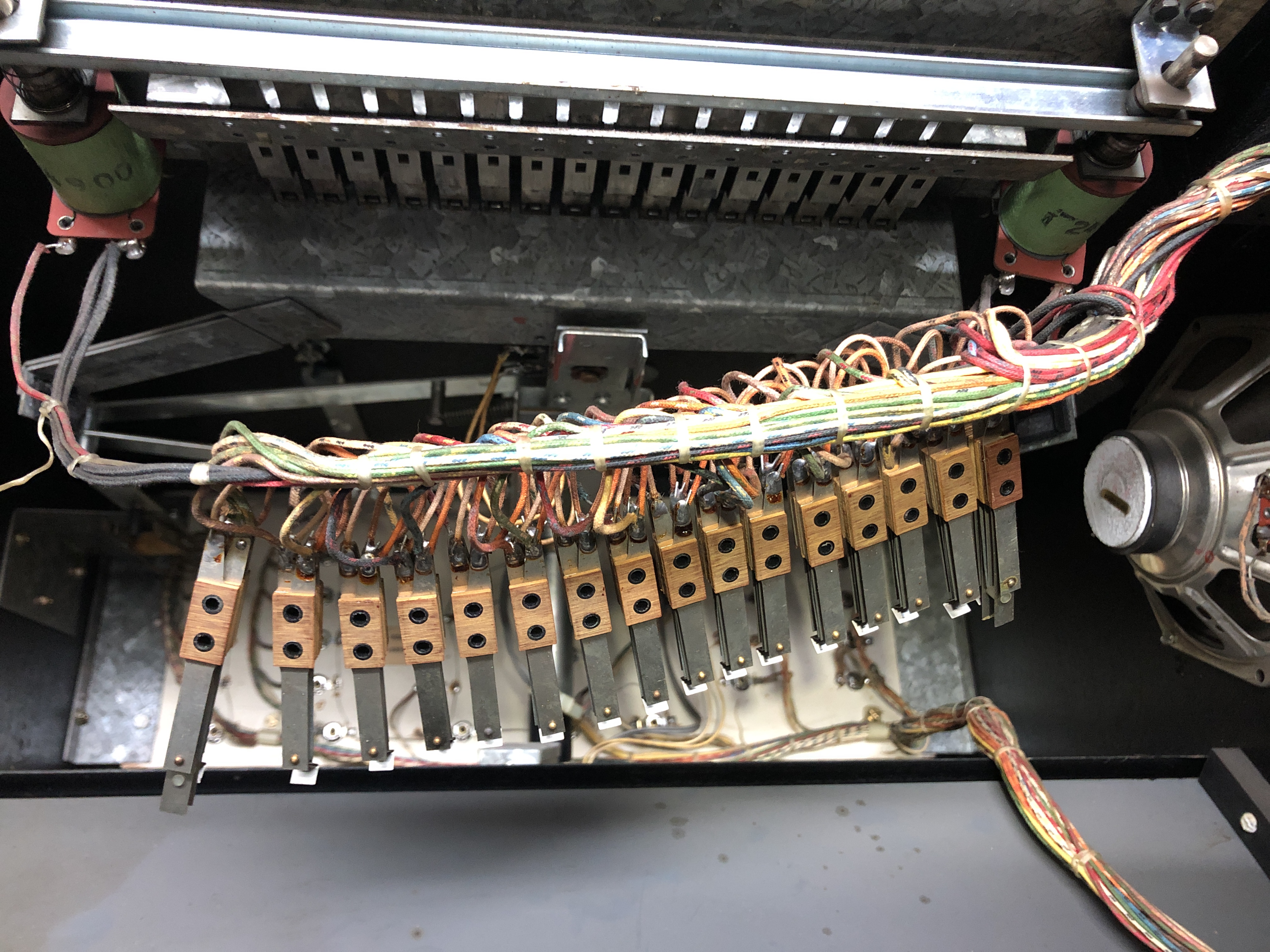
The selector unit switches had to be cleaned. The unit is at the very top of the cabinet. Most of the wires used for this sub assembly are solid wires. I thought it better to unscrew all of the stacks at once instead of one at a time and risk breaking a wire. Top switches are for ship hit detection. Bottom switches are for guiding the torpedo arm left or right. Each switch stack had to be handled gingerly to avoid it falling apart. Cleaned the switch points with a flex stone and a small wire brush. While the unit was apart I found a few wires that were improperly soldered.
Torpedo course arm unit:
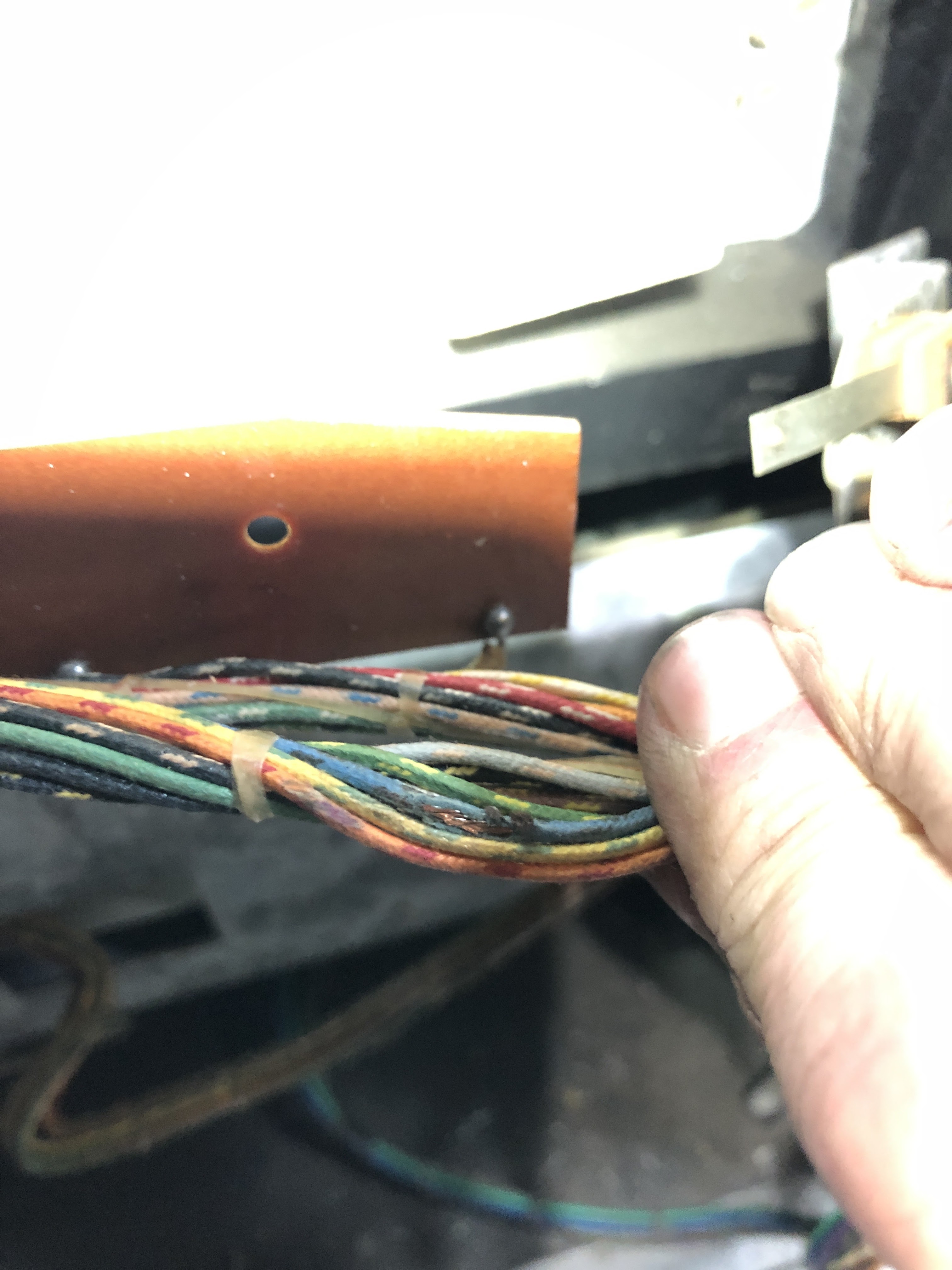
One of the machines had some damage to the torpedo course arm unit wiring loom. Part of the torpedo arm rubbed on the wiring that interfered with the arm at end of stroke. That made the whole assembly a shock hazard. Got a good zap off that one. Simple electrical tape fix and I properly tucked away the wiring loom to stop it from rubbing.
New lamps for Sea Raider:
Sea Raider uses #1895 12V bulbs throughout the game. These are getting harder to find now. I bought some N.O.S. bulbs from eBay.


Jones connector at the bottom of the cabinet (not pictured):
There is a Jones connector at the very bottom of the cabinet. It is used for the coin door and the neon light power. In both games, that connector was problematic and had to be addressed.
Sound Unit:
Sea Raider has a sound unit that produces three distinct sound effects: a radar ping (beep), torpedo white noise once a torpedo is launched and an explosion sound for torpedo/ship hits.
One one of my machine, the sound unit worked perfectly.
One the other machine, the radar pings didn't work. I had to replace two capacitors. From experience working on a few games from that era, the old silver Sprague capacitors tend to be problematic.

I didn't have any axial capacitors of the right value on hand so I will have to make do with radial caps. They look sorta bodged in, and they are.

Sound board diagram for dummies
In conclusion, Sea Raider is an ideal addition to a game room. It has a small footprint, it's simple (to repair and to play) and it's an artifact of the silver age of the coin-operated amusement industry. I recommend it as a novelty in any pinball heavy game room.
Links/ references:
Pete's Game room Sea Raider repair


