Showing posts with label horse racing. Show all posts

Tuesday, November 2, 2021

Derby Triple 300 Showa era medal game

Presenting... another obscure horse racing themed game: Derby Triple 300


The Manufacturer and the year of production are unknown to me but I suspect it's from the early 70's.

One of my main collecting interests is electromechanical gambling machines. Earlier this year I became interested in Japanese gambling machines. I started perusing Yahoo Japan Auctions and stumbled upon an auction listing for a machine called New Mini Derby.


But more importantly, I became intrigued the the machines inner workings.


From the outside the machine looked alot like what was offered in Great Britain at the time but the inner workings are way more intricate.


The auction price for the New Mini Derby was a bit too much for me and I passed on it but soon after I found a listing for Derby Triple 300 so I purchased it off YJA.


I bought the game almost unseen. The machine was listed as Junk, but working. Locked with no key and there were no pictures to attest that the games was complete. I took a chance. The game was very similar to the New Mini Derby and I suspect it was produced by the same manufacturer. I presumed it was electromechanical because the play features were relatively simple.

It arrived in a very large box delivered by courier.


When I got the machine unpacked it was indeed locked, but with a bit of gentle prying, I got the game opened, and was happy to see it was complete except for the missing coin box. Its electromechanical alright... with 50 relays!

The box was obviously knocked about in transit and a few parts were out of place, Notably the payout tubes and a few printed circuit boards.


I also found a bit of treasure inside: One 1 Yen coin, one 5 Yen coin, one 100 Yen coin, 4 10 Yen coins and 20-ish Bally 10 Yen coin sized tokens. Score!


I gave the machine a good visual inspection. Put all the loose parts back in their place. Made sure there were no broken parts and that nothing (like a loose coin) might cause a short circuit.

Looked at the electrical nameplate. Despite the operation voltage indicated at 125V I had my doubts and ran the game off a variable transformer adjusted to 100V since the game is a Japanese domestic unit.


Inspected the Transformer, bridge rectifier and fuses that were hidden behind a panel. Notice the multiple taps off the secondary, probably to compensate for line voltage.


Once I ascertained the machine was electrically sound, I plugged it in and the game lit up.


I then flicked the coin switch and started a game. It didn't function very well but I could see the game had potential.

For repairs, I started by burnishing the pads on the printed circuit boards and I cleaned the wipers. There was a patina of oxidation on pretty much everything. 


There are 5 similar boards, each with a low RPM motor and a wiper. I don't have any technical details, but I suspect one is for the game sequence, one is for payout impulse, one is for flasher animation, one is for random odds and one is for random selection. None of the relays are labeled and I haven't taken the time yet to figure out what each one does.

The game is well built with quality connectors. All the Relays are Omron sealed relays mounted on socket bases. The lamps used are 30V ba9s base and replacements can be easily found.

The machine has a basic attract mode where two lamps behind the panel "Derby Triple 300" flash alternately by way of a simple flasher circuit when the game stands unused. The flasher is interrupted when the machines is coined up and resumes after a spin cycle.


The machine uses an adjustable coin rejector and I adjusted it to .984 standard pachislo tokens.


The coin slot has a coin lockout coil. 


The buttons used are high quality industrial grade buttons.


It has a basic sound circuit and speaker that approximates the sound of running horses during a spin cycle. The volume potentiometer was bad and needed replacement. There is another small potentiometer for the "galloping speed" adjustment.


There are 2 payout tubes and the payout solenoids deal the coins in stacks of 5. The payout slide mechanisms needed a but of degreasing and a fresh re-lubrication.


Hidden behind the coin tubes there are three small stepper units that I suspect are for some mixer circuit and 4 toggle switches that are probably for payout percentages. The steppers advance one step each spin cycle.

Sadly, not having any instruction or schematics, I may never know their purpose for sure.


SO HOW DO YOU PLAY IT?

First insert a coin. Coin lockout solenoid then energises stopping you from inserting additional coins until a selection is made.

Yellow arrows light up to indicate selection choices. Press button under number 1 to 6 to select.


Once a selection in made additional coins may be deposited for more selections or to multiply potential payout of any selection so that each selection may have up to 3 coins wagered. With 6 selections thats a potential of 18 coins per play.


Once selections are made, press large button to start the spin cycle.


Spin section has two parts. One is to determine the payout (10, 20, 30 or JP (Jackpot is 100)) 


The other is to determine winning selection. The spin cycle can land on any if the 18 panels. Not just panels 1 to 6.


If the end of the spin cycle lands on a lit selection, you win. Maximum possible is 300 tokens. "Payout" panel is lit during payout cycle.


If you have any additional information or historical context about these early Japanese medal games please leave a comment.

Thursday, October 1, 2020

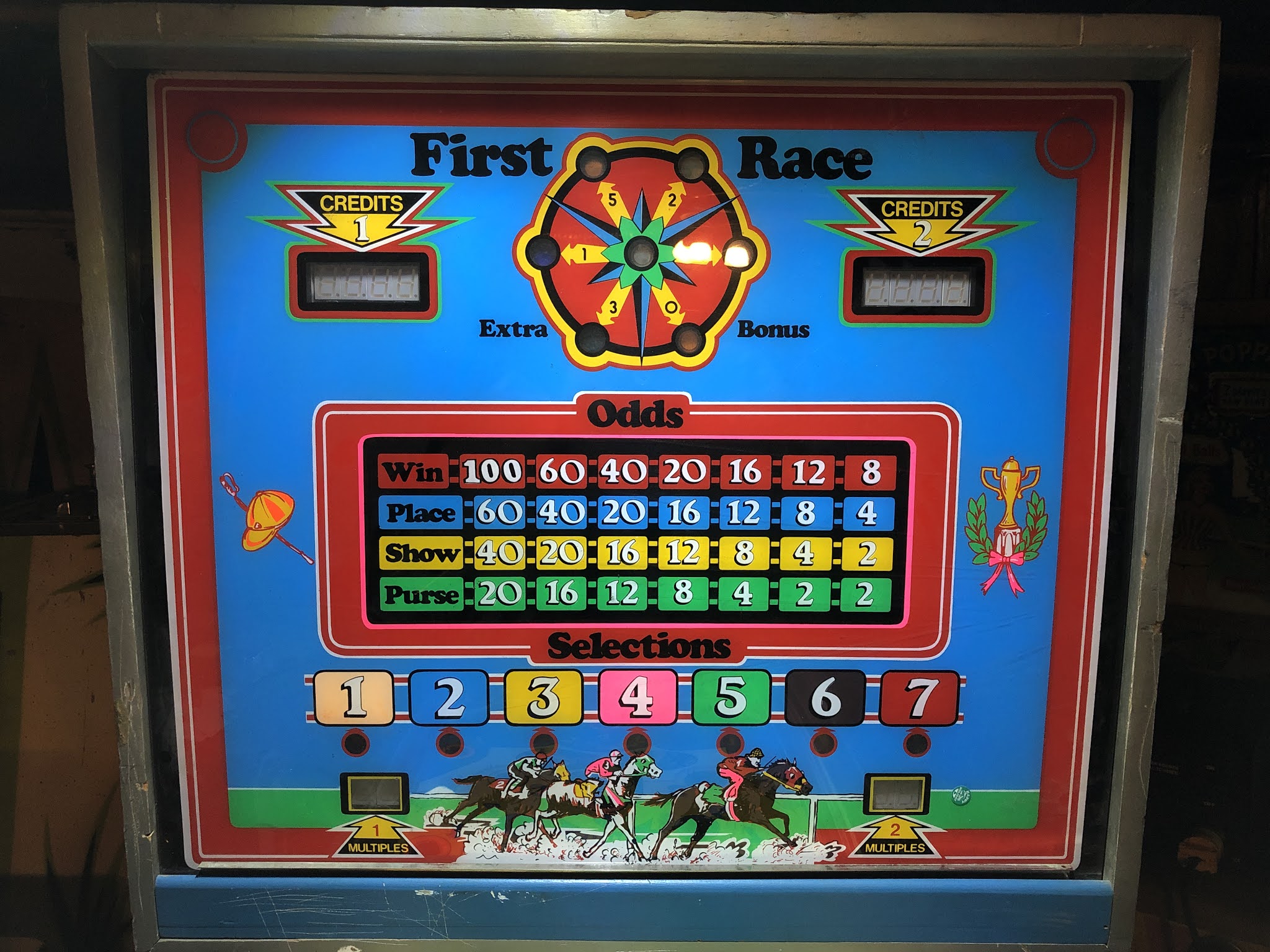
First Race: Solid State One Ball Horse Racing Pinball repairs continued

First Race Solid State One ball horse racing flipperless payout pinball

This is my third detailed post about First Race, a solid state one ball horse racing gambling machine. As I write this post, there are no other known examples of this game. The manufacturer is unknown and the machine was last operated in South Africa. The machine was extensively played judging by the playfied wear.

First Race might be a prototype, a one off or the last of its kind. Who knows! There isn't any information about it.

I found the machine at a pinball re-seller in Montreal. It was sitting there for years before I acquired it. I'm not usually into electronic amusement machines but I couldn't let this one pass.

Here are my previous posts about First Race:

First Race: Solid State One Ball Horse Racing Pinball Unknown Manufacturer

First Race One Ball Horse Racing Payout Pinball: Overview and repairs

Here are a few detail pictures:

Backglass: It's made of plexiglass. Notice the lack of manufacturer's name or logo. Also notice the odds are displayed reverse of my 1949 Bally Champion. Left to right the odds are displayed decreasing instead of increasing like on the Bally Champion.


Playfield is nicely screened but artwork is sparse and the paint is thin. The rebound and flag springs are made of plastic. Very 90's.

Bottom left and right trap holes are ball returns. Center bottom trap hole pays out purse odds.


Here's a view of the inside of the front of the cabinet. Notice the coin meter. It adds up the number of credits knocked off via the hidden credit reset button.


The coindoor. Red button is for "extra bonus" feature. Yellow button is to play credits if the coin tube is empty. Coin tube can hold about 90 Nickels. Seems a bit contrary to bingo machine symbology where the red button is to play credits and yellow button is to play for extra balls. I will probably end up swapping the button lenses around.


Inside of coin door. Door is simple thick gauge steel. Very basic. The coin rejector is adjustable. Video poker machine buttons.


Where I left off last post. I suspected the shutter motor had a problem. I took apart the motor and the armature brake mechanism is definitely broken. There's supposed to be 2 tabs, opposed 180 degrees on what I can describe as an armature brake disc made of black plastic. Both tabs are broken.

The result is that when de-energised, the armature keeps spinning freely for too long. The shutter cam triggers the carryover switch and the motor powers up. It gets stuck into a perpetual cycle.

Looking on ebay. I found similar Crouzet motors that I could probably use to swap out the brake mechanism but they are all listed for 100's of dollars. That's a bit too much for me. Until I can find a (affordable) suitable replacement, I will disable the motor and push the shutter by hand.


Motor armature with the broken brake disc.


After getting a 120 to 240 Volt converter and replacing a broken relay, the machine could coin up but the shutter switches would cause the machine to freak out. Only the 6's would pay out correctly. I took out the main board and re-seated all the integrated circuits and changed out the chips with tarnished pins that went black / brown. This however did not solve the switch issue...

I took the time to trace out the wiring to a DB9 and DB25 connector on the main board. This allowed me to better understand the architecture of the game. There might be future revisions of the pinout chart...


The coin switch and yellow button go through a flimsy looking assembly with a 4093 ic with two transistors. I had my doubts about the assembly so I took it out for closer inspection.


Once the assembly was out, I could see that there was a broken wire and a broken pin on the ic socket.


I re-made the assembly with an actual pcb. Makes it less flimsy and with the new unit reinstalled. The switch payout problems were gone.


At this point I'm happy with the state of the machine. The game coins up. The switch logic is good and the machine pays out correctly. The wiring could use a bit of tidying up... all in good time. The situation with the motor is unfortunate but I might be able to repair it in the future OR shoehorn in a different motor to do the job. I would prefer the former.

If you stumble upon this post and you are into weird and rare gambling machines, please consider sharing this post. I don't have any information about First Race. I'm looking for any information about it. Where it came from, who made it, production details, documentation, manual, schematic, score and information cards. 
 

Thursday, September 24, 2020

First Race One Ball Horse Racing Payout Pinball: Overview and repairs

 First Race One Ball Horse Racing Payout Pinball


Thank to Cait and Danny who shared the initial post about this game. I got almost 100 views in the first 24 hours because of their efforts. It usually takes a couple of years for any of my other posts to reach that many hits. If you stumble upon this post and you are into weird and rare gambling machines, please consider sharing this post. I don't have any information about First Race. I'm looking for any information about it. Where it came from, who made it, production details, documentation, manual, schematic, score and information cards. 

As can be noticed, First Race is shown powered up. Here are the details of what's been done so far to get to that point.

Here's a short video I posted on Youtube of the machine on attract mode:


Here's a few playfield details:


Here's a better view of the payout tube and the latch bar solenoid that spits out the coins. The mechanism didn't require any work and works properly on Canadian Nickels. The electrical tape is to stop the terminals on the microswitch from shorting out on the metal mechanism. The switch is to detect if there's enough coins stacked in the payout tube.


Look at the size of the coin box for First Race. It's huge!


The shooter lane and ball shooter gauge


Just look at the shooter lane wear by the manual ball lift and the ball detector switch.


Despite the machine being fitted with a North American standard 120V plug when I acquired it. The machine's transformer is wired for 220V input only.

Plugged as is on 120V, the transformer only outputs half of what it's supposed to.

The transformer normally outputs, 6V, 14V and 24V.

The 14V then goes to a bridge rectifier. The 14V is for all the lights.

The Transformer module will require a bit of repairs to make it safe. Notice the lack of fuses!

Also it looks like this transformer is a replacement of some previous transformer that burned out. Yummy!


I had to go downtown and buy a 120 to 240V converter to properly power First Race.
1000W is more than enough.


The main board is powered by a videogame transformer that outputs +12V, GND, +5V and -5V. 

The power supply can take 120V or 240V input and will output the correct voltages either way. But without the converter none of the lamps or solenoids worked.


Here again, a bypassed fuse. This one is for the line voltage. That's super sketchy.


I had to repair that. I also replaced the marettes by closed end crimp terminals.


There was a beat up looking relay inside the head. It didn't actuate properly and the SPDT switches (in this application only one switch is used) were bent out of shape. It's a 24V relay.

Also, notice the dodgy 4093 chip and a socket, the whole thing dangling in the breeze.


I looked in my stash of parts and found a replacement relay and base. There are industrial parts.
I solder spliced and shrink tubed the wires.


Here's the completed relay swap. Once fixed. I found out that it energises and remains energised when the game is coined up. Relay is de-energised when the ball sits in the shooter lane.


Then I took apart the shutter to inspect the switches and wiring.


Shutter motor is a 25 rpm Crouzet motor. It's geared for 50 Hz so it spins 20% too fast on North American 60 Hz alternating current I think this one is faulty... it keeps spinning for a bit too long on inertia. Looks like it has a faulty brake mechanism.


One side of the switch is a panhead brass machine screw. Other side uses an high silver content alloy contact point. All the switched were filthy and had to be burnished.


All the playfield switch wiring goes to this strip....


Then to this connector in the head. The to a DB-25 connector on the main board (not shown)


First Race is a work in progress, more details to come as the repairs progress.


Please share and comment.