The other day I had this urge:
I had to play my 1949 Bally Champion One Ball game.
I had to play it while listening to Ziggy Stardust.

So there I stood, in front of the machine.
Playing down credits and singing along. Screaming "FIVE YEARS" over and over.
Win some credits, lose some credits (mostly lose)
Singing along.

By the time Suffragette City was playing I got bored of Champion and I was playing the pitch and bat game.
Press the pitch button. Slam the bat button. The running man unit going round and round.
Bowie at max volume. I got this rush of memories.
I remembered this woman I dated back in 2005.
Even back then I had a house full of arcade machines.
We went on this road-trip around the Gaspé peninsula in my old Jetta. We made Super 8 films.
We dated for a couple of brief summer months only because she was about to leave for this big trip / life project to Africa.
I remembered her explaining to me who were the Suffragettes were.
Don't get attached, she said.

___________________________________________________________________________
So... back to Champion.
But first, what exactly is Champion?
It's a type of flipperless gambling pinball machine where the basic object of the game is to shoot one ball into a winning trap hole.
One ball games often had horse racing themes. There types of games were eventually outlawed and were succeeded by Bingo machines in that segment of the amusement industry.
I acquired this game in 2019. Drove to Orillia Ontario to get it. Bought it from a fellow pinball collector.
After loading up the game in my van. As we were leaving, I remember saying to my then girlfriend: "this game is an wreck, an absolute boat anchor."
The backglass was roached. The cabinet was broken. All the Jones connectors between the head and the body were wrecked.
So why did I get this one ball? Because it was available and it was cheap.
I wanted to own a One Ball to experience it as a repair tech, see how it works, how to work on it, ease of maintenance and obviously... how it plays.
I made a couple of half ass posts about this game on this blog back then but I never took the time to explain the features and game-play of Champion.
The game sorta disappeared from the blog.
The repairs
I patched up the cabinet and replaced the Jones connectors.


The rest of the repairs were straightforward. Free up the steppers. Clean the wiper discs. Burnish the switch points.
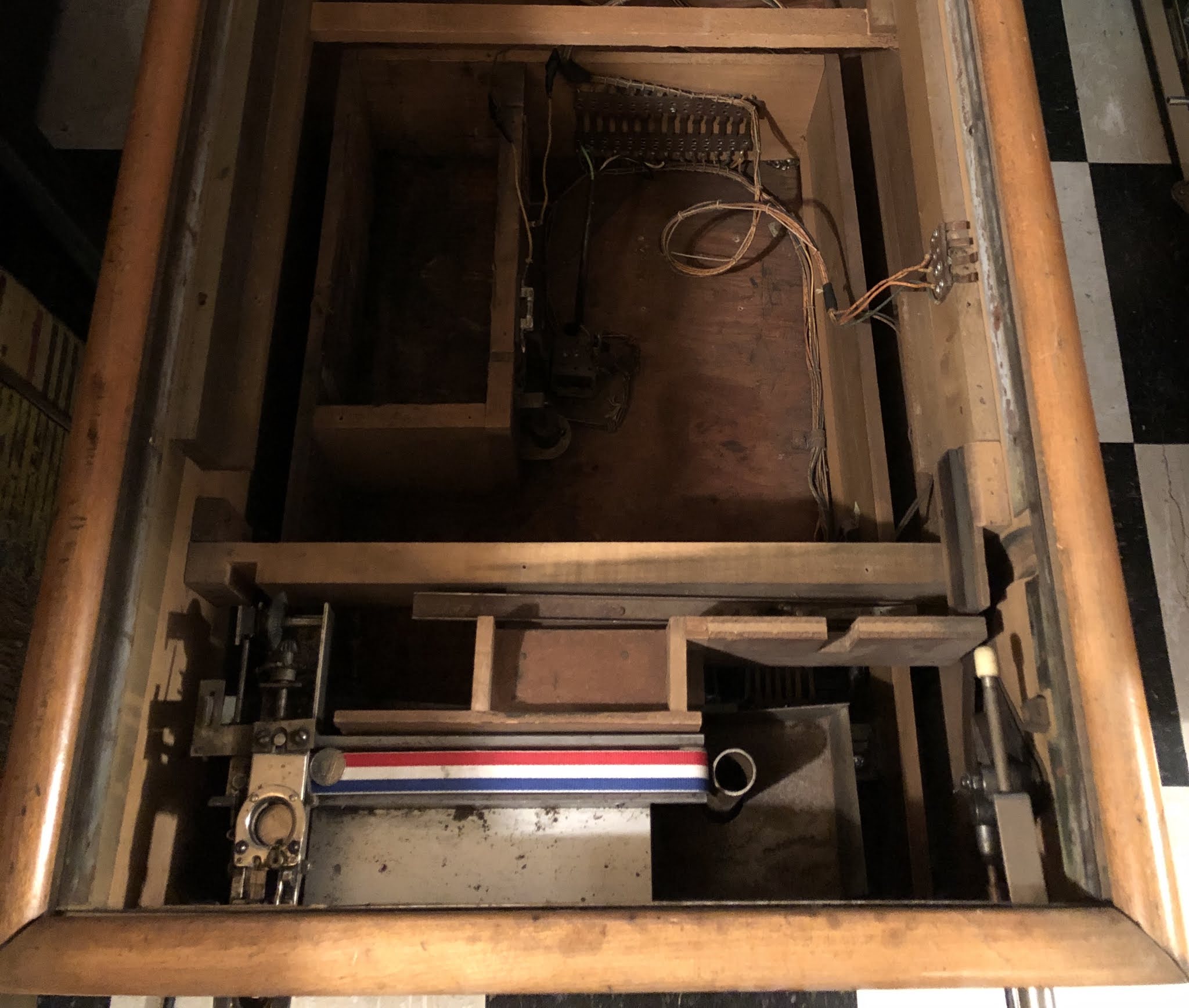
The inside of the cabinet is all contaminated with oil fume from the control unit motor. That fouls up the switch points fairly quickly.
The schematics are not as convoluted as a bingo machine and the manual is well detailed, which helped for troubleshooting.
The main mech panel pulls out of the front of the cabinet for ease of maintenance.

The only notable repair was replacing a bunch of old ceramic resistors that were bad. These resistors are part of the Payout Relay circuit.


New, this game must have been majestic.
Pictures do not convey how impressive and imposing these games are.
The backglass has an impressive amount of mirroring. The cabinet is huge.
The side art uses 6 colors on top of the base color. This was a premium product.
So how do you play Bally Champion One Ball.
First, let us go through the instruction card:

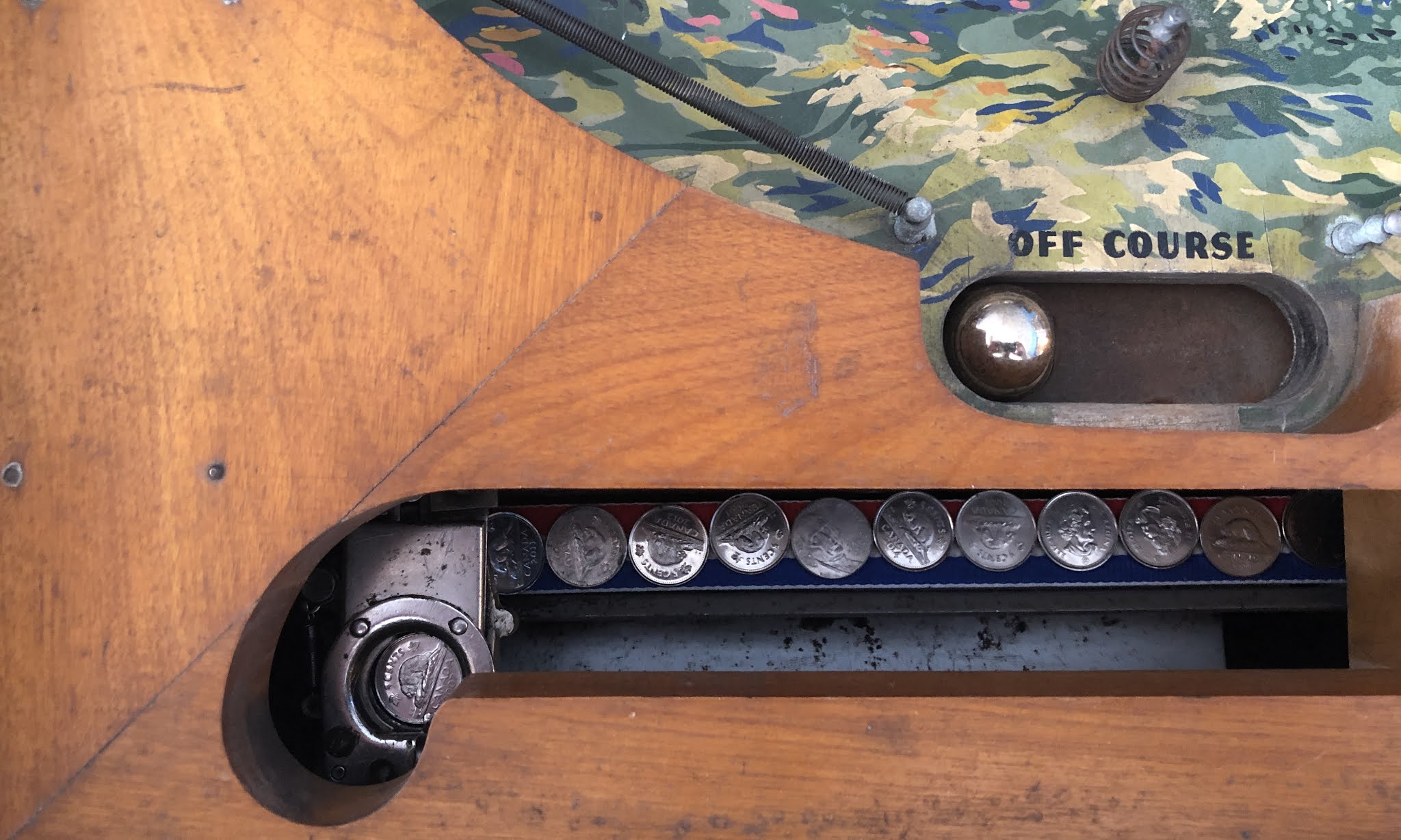
Drop a coin in the coin chute.

The game goes through it's reset cycle and releases the ball to the ball lift trough.
Lift the ball to the shooter lane using the ball lift plunger.
Upper plunger is the ball shooter.
Lower plunger if the ball lift.
 |
| Plunger and Ball Lift |
Drop additional coins to increase odds and randomly change selection(s).
At each spin cycle, the Selections might change or not. The Odds either stay or increase.
Once the player has satisfactory Odds and Selections: Shoot the ball into a winning hole.
Easy enough in principle.
But what are "Selections" and what are "Odds"?
 |
| Odds and Selections |
The Selection(s) are the big lit numbers (1 to 7) on the backglass that the player tries to shoot the One Ball in one of the corresponding playfield trap holes.
The Odds are the number of credits won when the player lands the ball in a wining trap hole.
There are four lines of odds on the backglass: Win, Place, Show and Purse. Terminology used in Parimutuel betting. These terms would have been very familiar when people used to "Play the Ponies".
The playfield is divided into four sections of numbered holes (1 to 7) Topmost section Purse, bottom most section Win. Show upper middle and Place lower middle. Purse pays-out the least, Win pays-out the most.
 |
| Playfield |
The best selection to have is 4. In each section, 4 hole is in the center. The playfield is pretty much designed to funnel the ball into one of the number 4 trap holes.
Selections 3 and 5 are pretty good. Very achievable to the lay player.
Selections 1, 2 6 and 7 are... Meh!
The Footrail Buttons
There are 3 buttons on Champion's Footrail: Replay, 1st Horse Shoe, 2nd Horse Shoe
 |
| Footrail buttons |
Replay Button
This button is used to play won credits off the replay register instead of dropping coins.
|
| Replay register |

First Horse-Shoe

The first horse shoe does quite a few things:
- First, once pressed, it locks in the Odds and the Selections. Very useful!
Then it does a bunch of random basis stuff:
- It allows you to bet for more and better (3-4-5) Selections. Once lit these Selections remain lit from one spin cycle to the next.
- It advances the WILD SECTIONS feature.
The WILD SELECTIONS feature panes(s) might advance one or multiple arrows. When the arrows have advanced enough steps, the whole word is lit starting by "WILD" then "PURSE" then "SHOW" etc.
WILD means that every trap hole in the lit section is a winning hole, regardless of the lit Selection(s).

The way this feature advances is a lot like the extra ball feature seen on bingo machines.
- It can randomly lights the panels
"PURSE SCORES WIN ODDS"
A balls that lands in a winning hole in the PURSE section will collect WIN section odds.
or
"SHOW SCORES WIN ODDS"
A balls that lands in a winning hole in the SHOW section will collect WIN section odds.
Note that these panels when lit do not remain lit from on spin cycle to the next so the player either has to shoot the ball or lock it in with the Second Horse-Shoe.
Second Horse-Shoe
- The second horse show can advance the odds on a random basis.
- It can randomly advance de WILD SELECTIONS
- It can randomly light the panels:
"WINNING BALL IN PURSE SCORES DOUBLE"
or
"WINNING BALL IN SHOW SCORES DOUBLE"
These two panels are pretty much self explanatory and these features do stack with the 1st Horse Shoe lit panels.

Personally I find the second horse-shoe to be useless and a bit of a scam. The odds of actually advancing the odds or any other feature are really bad. I never use it.
And judging by the wear on the footrail buttons, players back in the day didn't use it much either.
The features

A-B-C-D bumpers:
This feature isn't explained on the information cards.
There are 4 dead bumpers: 2 on the left side and 2 on the right side of the playfield lettered A, B, C and D.
The bumpers need to be hit in sequence (alphabetical order). Once hit a bumper remains lit.
All 4 bumpers don't have to be hit within the same game. The feature carries over from game to game until it is completed.
Once all 4 bumpers are hit (lit), ALL selections are lit for the next game.
Then the feature resets at the end of that game.

Light-a-name / Left and Right Trophy Cup
This is a LIGHT-A-NAME feature that carries over from game to game. Presumably to entice the player to keep playing.
Notice that only the "CHA" of the CHAMPION name is lit. This is the basic state of the feature.

Occasionally a trophy cup in the bottom left or right of the backglass will be lit. Under the trophy cup there is a lit number 1, 2 or 4.
If the player locks in the Selections with the 1st Horse Shoe button while a trophy cup is lit, the lit trophy cup will alternate L and R from one spin cycle to the next.
Left Trophy Cup

Right Trophy Cup

Landing the ball in the correct (lit) trophy cup trap hole will light the next letter in CHAMPION and scores the number of replays under the lit trophy cup.


The player that lights the last letter in CHAMPION wins 40 replays multiplied by the lit number under the trophy cup.

Then the feature resets at the beginning of the next game.
Feature Feature
This is the rarest and most elusive feature of Champion.
There's this small window at the top-ish right of the backglass. It looks like a credit display. This is the Feature Points display. It advances on a random basis. It advances mostly unnoticed. It starts at 0 and can go up to 50 but on my game it's limited to 45. The display does not reset at the start of a new game, it carries over from game to game, surreptitiously advancing.

After every spin cycle, the player has to watch out for the small FEATURE panel on the backglass to check it stays lit.

When lit, the player can try to land the ball in the trap hole marked FEATURE at the bottom of the playfield.

If the player manages to land the ball in the feature hole, the player wins 20 times the displayed Feature Points.
This feature, when achieved, was payed out directly in cash (or store credits) by the establishment.
There is a dedicated hidden Knock-Off button that the attendant would press that resets the feature counter in circuit with the feature trap hole switch.
Imagine: 20 multiplied by 45. That's 900 credits. These games were set up for Nickles or Dimes. (Dimes in my example.) That's potentially 90 bucks in 1949 money!
In today's money, adjusted for inflation, that would be well over a thousand dollars buying power!
Nice payday.
____________________________________________________________________________
That's the Champion one ball game. I hope you enjoyed this post or at least found it informative. It took an eternity to write it up. The subject matter is so dry. The features mildly convoluted. Writing about One Ball game features is like trying to describe enthusiastically the process of paint drying.
What does the future hold for these one ball games? Collectors for this type of game are few and far between. In most places, these games were outlawed 75 years ago. Today there's no real interest in these games. They're big, heavy and not fun or interesting for the regular pinball enthusiast. Potential collectors that would have played these games in their youth are now in their 70's or older. Specific parts are difficult to come by. I think this is the last hurrah of the one ball games. Games in good condition might find takers but for the games in poor condition, the future is grim. Time to document them and share the information online with other niche interest pinball enthusiasts.
As for my Champion, I'm pretty much tired of having it. It's in poor condition cosmetically. It takes a lot of space and I rarely play it. It's too big to move and it's unlikely I'll find a local collector that would take it. I might end up parting it out and chopping up the cabinet.
Standing in front of my stereo screaming out the lyrics.

Don't get attached, she said.