Tuesday, November 2, 2021

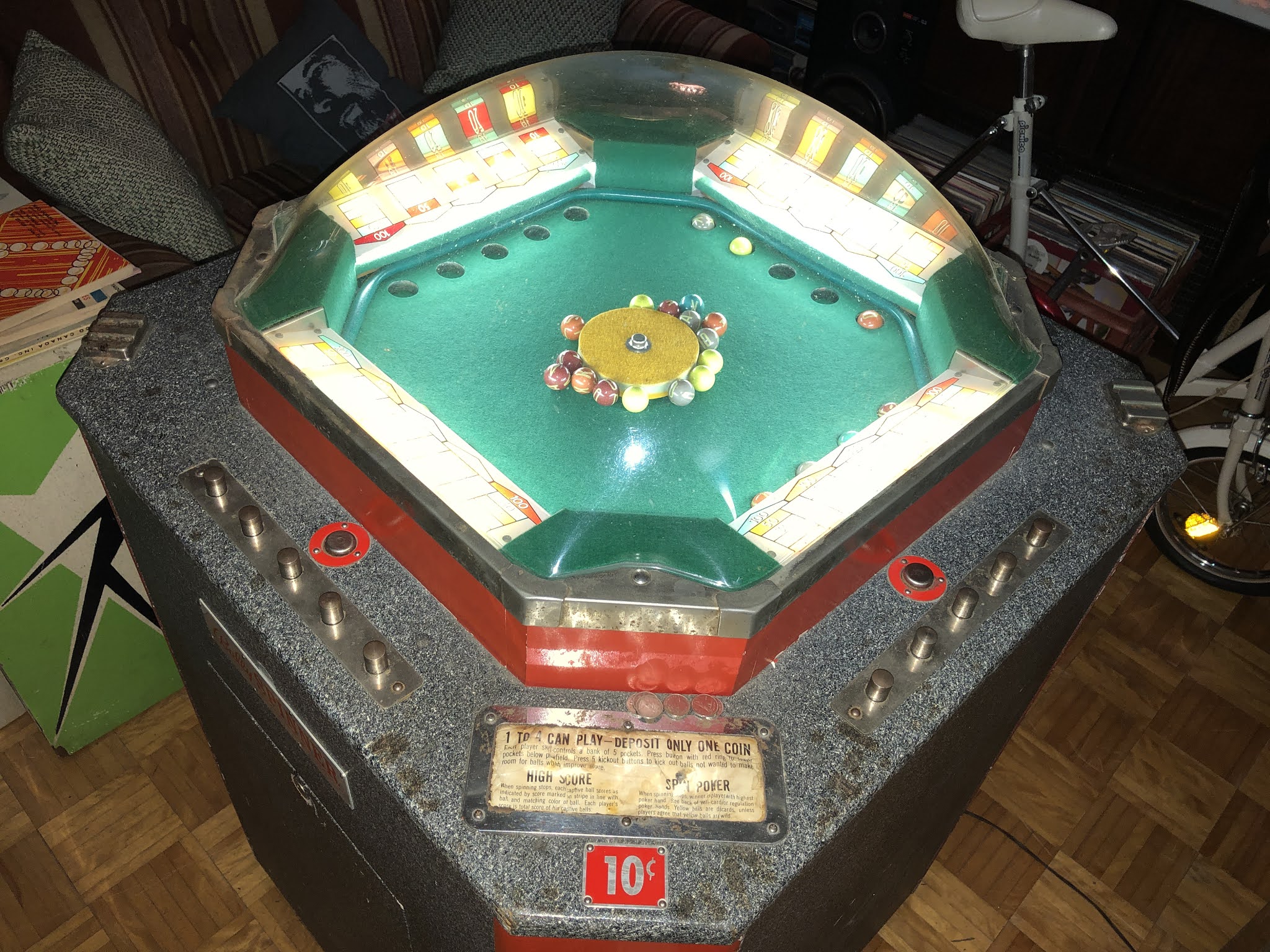
Derby Triple 300 Showa era medal game

Presenting... another obscure horse racing themed game: Derby Triple 300


The Manufacturer and the year of production are unknown to me but I suspect it's from the early 70's.

One of my main collecting interests is electromechanical gambling machines. Earlier this year I became interested in Japanese gambling machines. I started perusing Yahoo Japan Auctions and stumbled upon an auction listing for a machine called New Mini Derby.


But more importantly, I became intrigued the the machines inner workings.


From the outside the machine looked alot like what was offered in Great Britain at the time but the inner workings are way more intricate.


The auction price for the New Mini Derby was a bit too much for me and I passed on it but soon after I found a listing for Derby Triple 300 so I purchased it off YJA.


I bought the game almost unseen. The machine was listed as Junk, but working. Locked with no key and there were no pictures to attest that the games was complete. I took a chance. The game was very similar to the New Mini Derby and I suspect it was produced by the same manufacturer. I presumed it was electromechanical because the play features were relatively simple.

It arrived in a very large box delivered by courier.


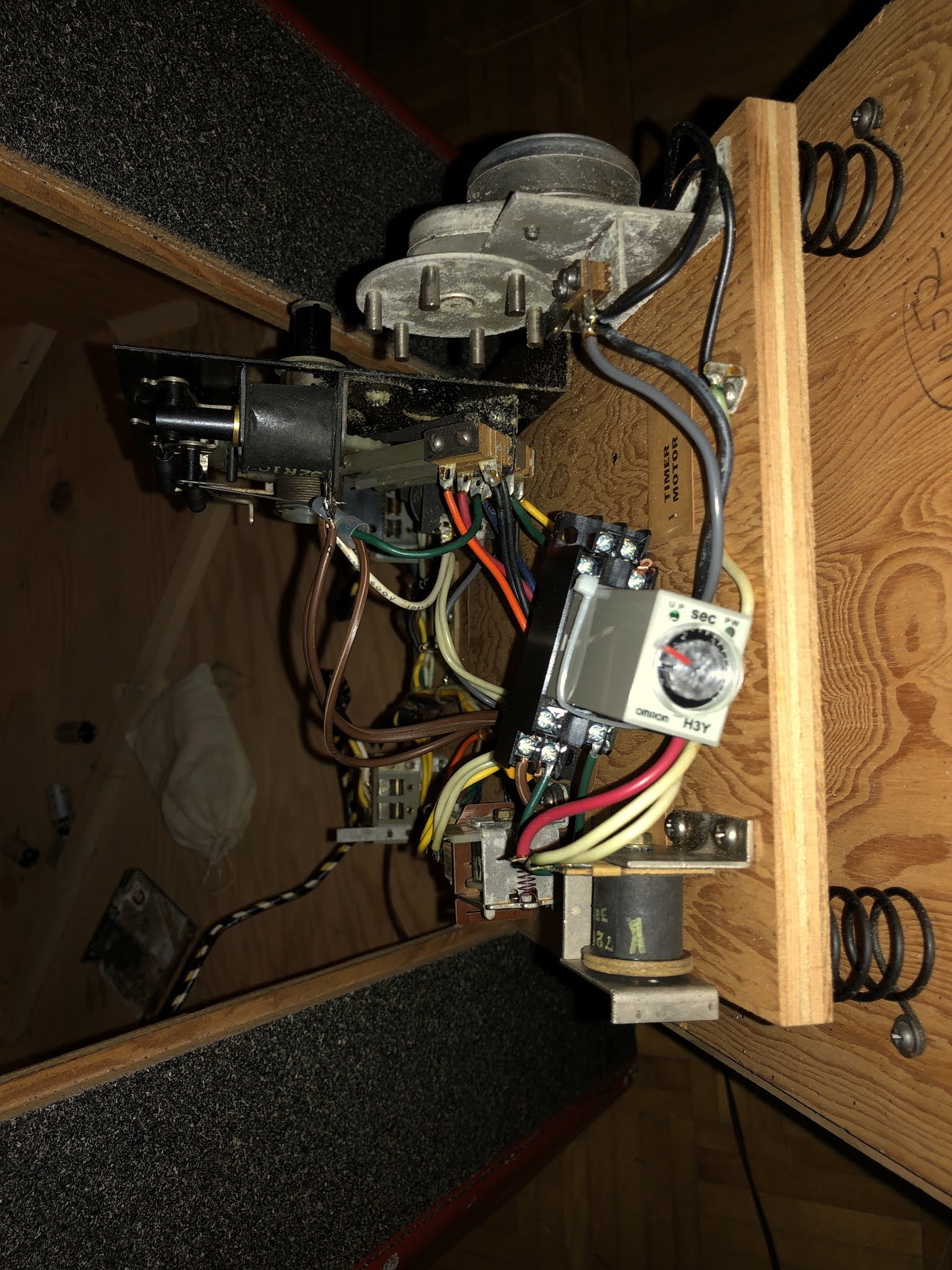
When I got the machine unpacked it was indeed locked, but with a bit of gentle prying, I got the game opened, and was happy to see it was complete except for the missing coin box. Its electromechanical alright... with 50 relays!

The box was obviously knocked about in transit and a few parts were out of place, Notably the payout tubes and a few printed circuit boards.


I also found a bit of treasure inside: One 1 Yen coin, one 5 Yen coin, one 100 Yen coin, 4 10 Yen coins and 20-ish Bally 10 Yen coin sized tokens. Score!


I gave the machine a good visual inspection. Put all the loose parts back in their place. Made sure there were no broken parts and that nothing (like a loose coin) might cause a short circuit.

Looked at the electrical nameplate. Despite the operation voltage indicated at 125V I had my doubts and ran the game off a variable transformer adjusted to 100V since the game is a Japanese domestic unit.


Inspected the Transformer, bridge rectifier and fuses that were hidden behind a panel. Notice the multiple taps off the secondary, probably to compensate for line voltage.


Once I ascertained the machine was electrically sound, I plugged it in and the game lit up.


I then flicked the coin switch and started a game. It didn't function very well but I could see the game had potential.

For repairs, I started by burnishing the pads on the printed circuit boards and I cleaned the wipers. There was a patina of oxidation on pretty much everything. 


There are 5 similar boards, each with a low RPM motor and a wiper. I don't have any technical details, but I suspect one is for the game sequence, one is for payout impulse, one is for flasher animation, one is for random odds and one is for random selection. None of the relays are labeled and I haven't taken the time yet to figure out what each one does.

The game is well built with quality connectors. All the Relays are Omron sealed relays mounted on socket bases. The lamps used are 30V ba9s base and replacements can be easily found.

The machine has a basic attract mode where two lamps behind the panel "Derby Triple 300" flash alternately by way of a simple flasher circuit when the game stands unused. The flasher is interrupted when the machines is coined up and resumes after a spin cycle.


The machine uses an adjustable coin rejector and I adjusted it to .984 standard pachislo tokens.


The coin slot has a coin lockout coil. 


The buttons used are high quality industrial grade buttons.


It has a basic sound circuit and speaker that approximates the sound of running horses during a spin cycle. The volume potentiometer was bad and needed replacement. There is another small potentiometer for the "galloping speed" adjustment.


There are 2 payout tubes and the payout solenoids deal the coins in stacks of 5. The payout slide mechanisms needed a but of degreasing and a fresh re-lubrication.


Hidden behind the coin tubes there are three small stepper units that I suspect are for some mixer circuit and 4 toggle switches that are probably for payout percentages. The steppers advance one step each spin cycle.

Sadly, not having any instruction or schematics, I may never know their purpose for sure.


SO HOW DO YOU PLAY IT?

First insert a coin. Coin lockout solenoid then energises stopping you from inserting additional coins until a selection is made.

Yellow arrows light up to indicate selection choices. Press button under number 1 to 6 to select.


Once a selection in made additional coins may be deposited for more selections or to multiply potential payout of any selection so that each selection may have up to 3 coins wagered. With 6 selections thats a potential of 18 coins per play.


Once selections are made, press large button to start the spin cycle.


Spin section has two parts. One is to determine the payout (10, 20, 30 or JP (Jackpot is 100)) 


The other is to determine winning selection. The spin cycle can land on any if the 18 panels. Not just panels 1 to 6.


If the end of the spin cycle lands on a lit selection, you win. Maximum possible is 300 tokens. "Payout" panel is lit during payout cycle.


If you have any additional information or historical context about these early Japanese medal games please leave a comment.

Monday, March 15, 2021

Testing of old pinball coils with a Megohmmeter

Do not attempt to replicate what I demonstrate in the post below.

High risk of electric shock!

You have been warned! 

This story started a long time ago. Like late 2014. I was fixing a United Singapore bingo machine. Everything was going well. The machine was ON and plugged in. Then, I touched the trip bank assembly reset arm and got a shock. Nothing dramatic but it was quite a zing.

I immediately suspected the large 120V reset coil, something like the coil's winding was shorting to the brass sleeve.

Back then I only had a crappy multimeter that didn't go into the megohm range.

Heck! It didn't even go that deep into the kiloohm range so when I measured between the winding and the brass sleeve, it measured open circuit. So based on my dodgy measurement device with a very limited range, the coil tested OK. Seemed fishy and I suspected the multimeted wasnt sensitive enough.

Fortunately, I had a spare coil, swapped it out, and no more getting zapped by the trip bank reset arm.


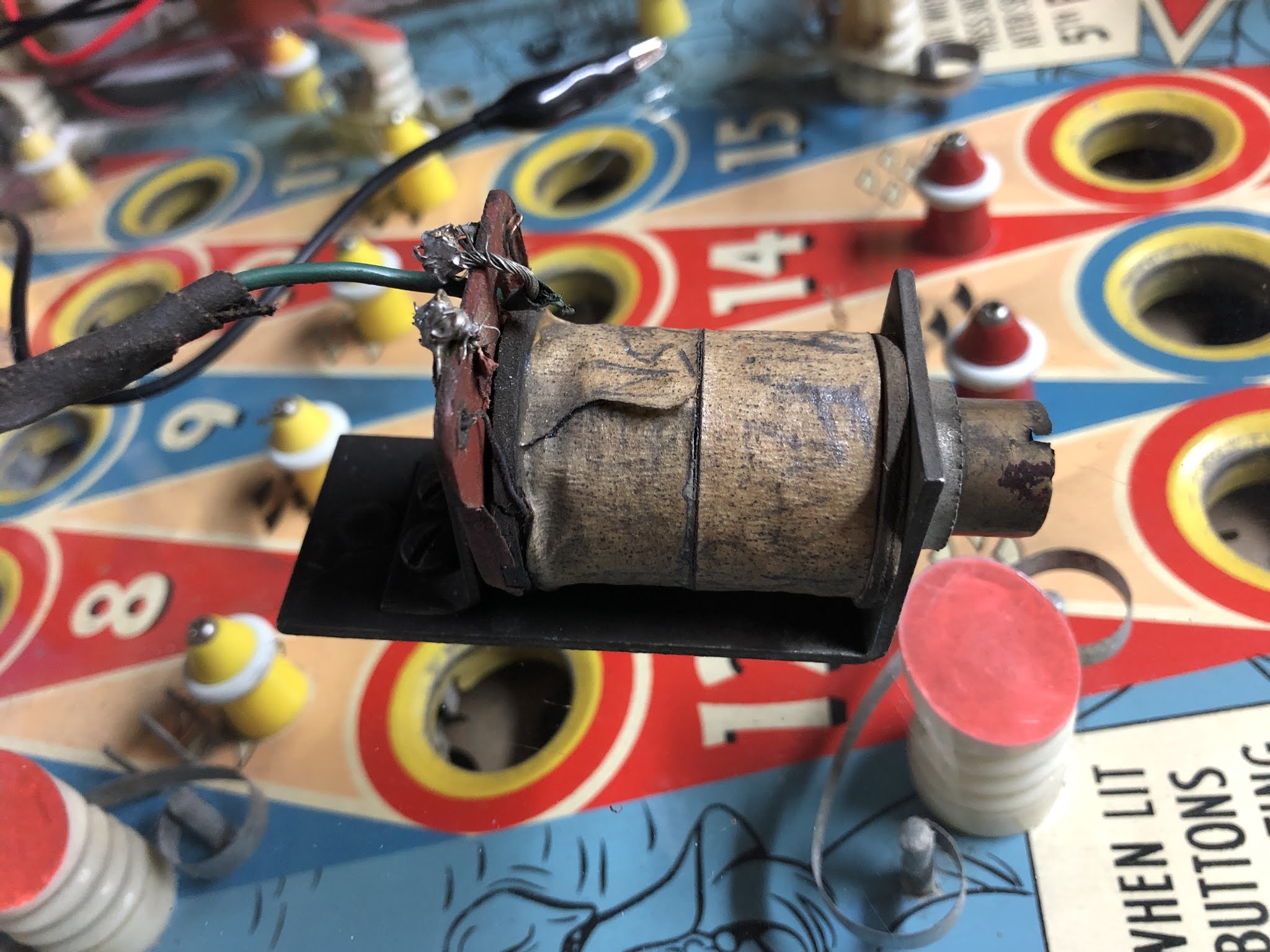
A few weeks ago I remembered the incident with the Singapore coil and it got me thinking. It piqued my curiosity. I looked through my pile of bad parts and found the bad coil in question (shown above).

I ordered a Chinese Megohmmeter off ebay, I think it was the lowest priced one for sale. I tested the coil with the Megohmmeter... 0.034 Megohms


Be careful when using a Megohmmeter. You can literally zap yourself with the probes!

Then I tested it with my current multimeter... 0.23 Megohms! There's like a factor of 10 difference between both measurements. Anyway, the coil is bad. That's an established fact. Good coils should measure open circuit between on of the lugs and the brass sleeve.


Then to illustrate just how bad the coil is: I put 120V on one of the coil lugs and measured between the bracket and ground... 119V. No wonder I got zapped all those years ago! 

Never play with line voltage! I'm demonstrating this so you don't have too. 


When working on old games with coils with brass sleeves, that's something to consider. The risk of getting zapped! The coil winding might be shorting to the brass sleeve and then conduct to whatever metal part the coil stop is in contact with.

The enameled wire might be damaged either from heat or wear. From factory there's a kind of cardboard insulator at the core between the sleeve and the winding but if the coil was re-wound, or if the coil got too hot at some point, that insulator might not be there anymore or may be ineffective.

So the moral of the story is if you want to fix old pinball / arcade / bingo machines buy a good multimeter. With the especially old coils test the resistance between the winding and the sleeve.


Sunday, February 21, 2021

1962 Bally Spinner revisited


So a while back I cured a recurring problem on a Bally Spinner...

I slowed down a stepper unit from resetting too fast using junk Bally stepper parts.

It can be seen here in a previous post.

This whole thing was a proof of concept really. I was curious if it would work. It does, but it's not flawless.

Since then I got a chinese copy of an Omron delay timer. All the junk parts are out.


Now the Omron timer delays the timer unit reset coil from energising by about 1 second during the game's reset cycle. Plenty of time for the ball dump motor and cam to do it's thing.

The delay timer is just shoehorned on to the control board. Secured by a zip tie. The modification is completely reversible if desired. It won't even leave a trace.


It works amazing!

Eventually I will get around to making a video of the reset sequence with the delay unit...

Thursday, February 11, 2021

1936 Bally Challenger One Ball Payout Pinball repairs

 Since the previous post

The cabinet was glued up. Looks like it was "repaired" at some point by a previous owner but ever since I got the game, the front left corner was split.

I got Challenger going. Fixing up the game wasn't really exciting stuff to write about.

All in all, there was 3 half ass days of work. Just basic stuff: clean, burnish, lubricate, look for obvious broken stuff then power up and troubleshoot. It's an exceeding simple game. My example of Challenger was fairly untouched, that helped a lot.

The game uses reed connectors that all need to be burnished. I use commercial grade green scotch brite pads I cut up into small squares.


Connections between head and body.

Took off the shutter to clean all the switches

I took out the payout unit, took it apart as much as I dared to clean and lubricate the moving parts. I noticed there was a seized sliding bracket. I had to let that marinate in oil for 24 hours and then with some patience and gentle persuasion managed the free up the part.


Embiggen for details

The payout drum has brass traces that needed to be burnished. I used a fiberglass sanding pen to clean the traces.

To help me with the repairs. I got a second Challenger parts machine from my friend Caitlyn. I don't know the machine's history or how she got the machine in the first place but it was very useful.

My Challenger

Cait's Challenger

The electromechanical bits in Caitlyn's game were completely modified. Apart from the odds drum unit, nothing was compatible with my example but the playfield was in a bit better condition than my example. My challenger has a dent in the playfield and most of the flag springs were broken. I decided to swap the best parts to the parts machine playfield and use that with my cabinet and head.

Batteries / Voltage:

Looking at the battery box in my Challenger and confirmed with Caitlyn's Challenger there were 10 batteries. Presuming that the machine used No 6, 1.5V dry cells, that would add up to 15 volts. Until I can find some suitable transformer, I will use a variac with a bridge rectifier and capacitor to power the game.

Looking at the playfield, I noticed a patent that wasn't mentioned in any of the ad's: 2,029,177 Game Apparatus by Bon MacDougall.


From what I understand from the IPDB entries Bon MacDougall was first employed, or at least designed for PAMCO then with Bally. That might explain the similarities between the One Balls produced by Bally and PAMCO.

Again, perusing IPDB, I found that the same game design was used multiple times by Bally and PAMCO...

Bally Derby, that conveniently has schematics. Speaking of schematics... also found a picture of the schematic for a Bally Prospector of the same era. Not exactly the same as Challenger but close enough to have a good idea of how it works.

PAMCO: Here are a few examples of one balls using the same electromechanical design and playfield layout.

Red Sails

Speedway

Parlay Senior, Notice it is almost identical to Bally Derby.

I think what differentiated Challenger from other similar One Ball games of the era is the multiplier.

How the feature works from the player's perspective, just like the red arrow says, first Nickel resets and starts the game. Manually raise the ball to the shooter lane. Then additional Nickels can be played to multiply the odds. Up to 3 additional Nickels for a 4X multiplier. Guaranteed step up for each Nickel played.

There are 6 odds steps: 2, 4, 6, 10, 16, 30

Payout odds are displayed for each numbered hole

The Odds Drum has a total of 24 odds combinations.


With a 4X multiplier, thats a maximum of 120 Nickels! Thats 6 bucks in 1936 money. Today that would be worth almost 113 dollars but consider that one play today would be worth about 1 dollar according to the US inflation calculator.

Electromechanically the multiplier is accomplished by way of a stepped plate that shifts 3 steps by way of a step up solenoid to push multiple payout slides. One slide pushes 2 Nickels at a time. There's a stack of 4 payout slides. At the start of a new game the multiplier is shifted to home position.


Game impressions:

The nautical artwork is absolutely beautiful. It's quality artwork that you would expect seeing as a framed print. The cabinet is tall and imposing. The diminutive head looks awkward on such a large cabinet.

It's as bland as you can imagine. Backbox lighting is minimal. The playfield layout, with all the flag springs makes it almost impossible to hit a hole that pays out. That's to be expected from a game that has all but one holes that pay out!

As for historical relevance, Challenger is an example of early games with changing odds. The "One Ball" concept is contrary to later One Balls. In other / later One ball games, only the lighted selections pay out, all the other holes lose. In Challenger, all the numbered holes pay. The Mystery Purse and the Grand Trophy hole pay an award of at least 10 nickels, all the way to 30 Nickels on a basic game. But the fact that's it's virtually impossible to hit a winner makes the game feel rigged and has little "play again appeal". I suspect the players who played these games when they were new caught on pretty fast. 

If you do manage to hit a winner. Coins drop into a spring loaded drawer.

The machine also has a EM sounder that knocks as coins are paid out. The sounder has an on/off switch for the operator.

Tilt Bob and Sounder

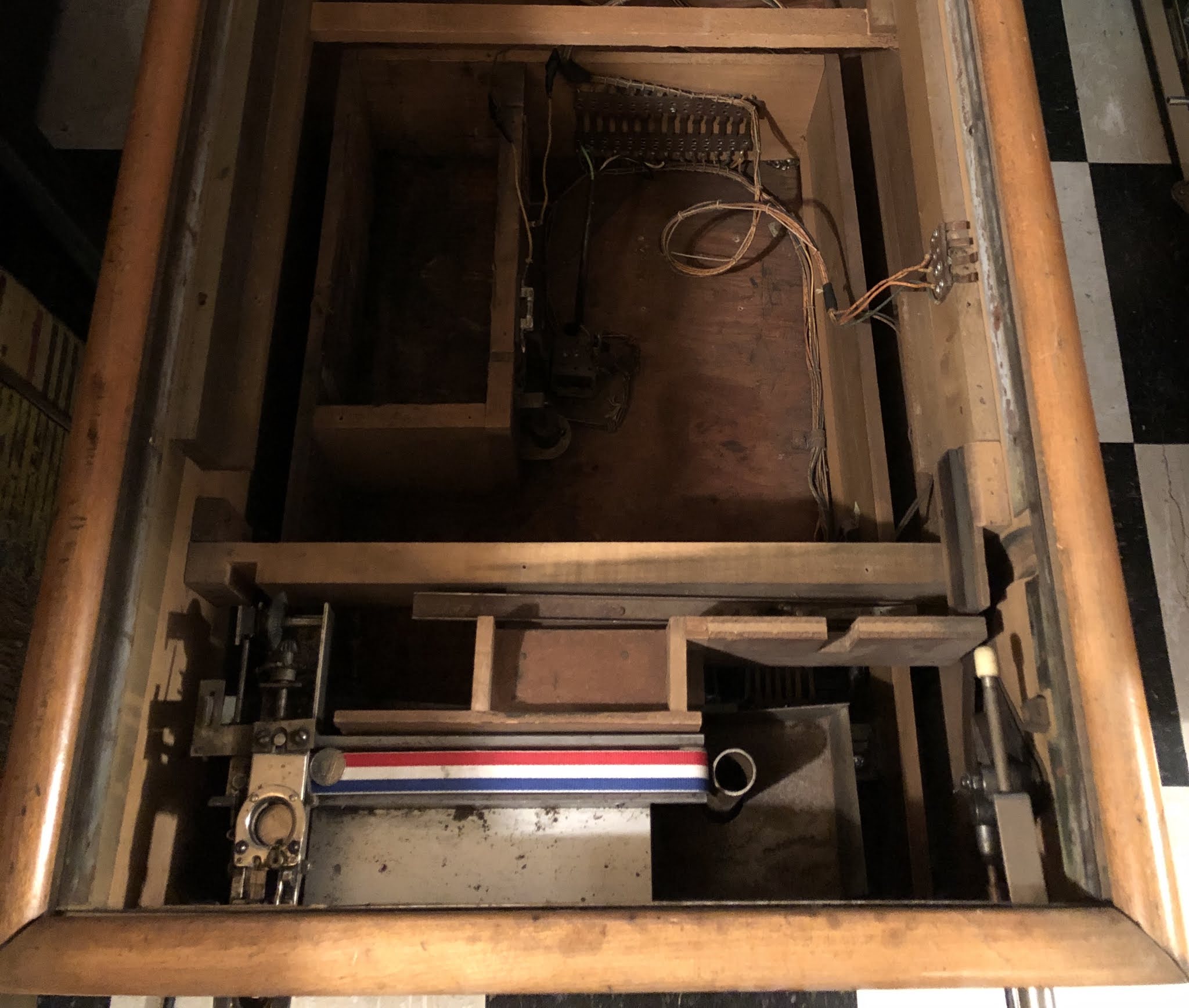
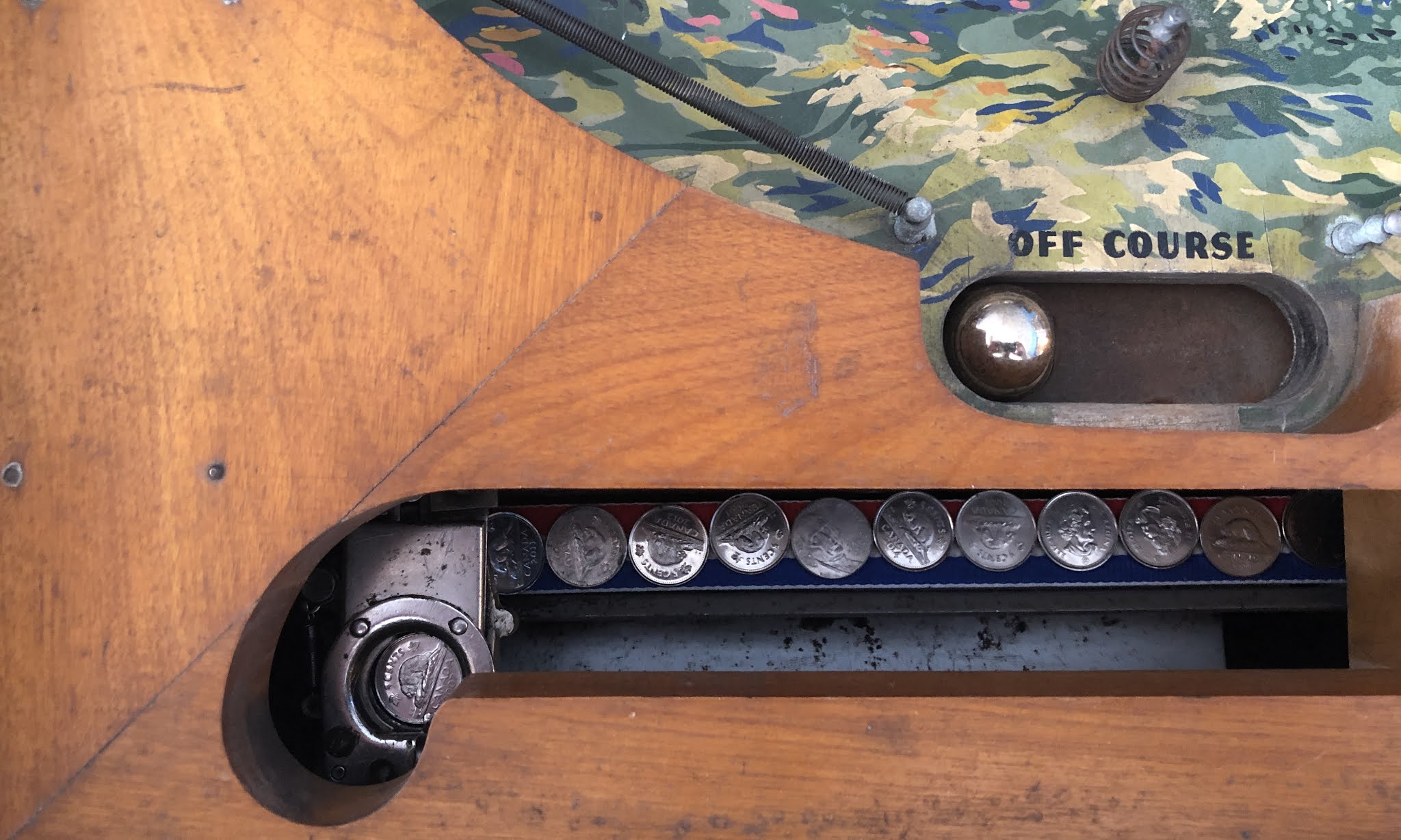
The game has a Nickel Validator (or would it be more appropriate to call it a conveyor or elevator... They call it an Escalator in the Flyer) To see if a player wasn't using wooden nickels or metal slugs. The coins drop into the payout tube at the end of the conveyor. Once full, excess Nickels drop into a cash box.


Friday, February 5, 2021

1936 Bally Challenger One Ball Payout pinball Introduction

1936 Bally Challenger One ball payout Introduction


As I write these words, it’s winter, I’m bored from my day job and there’s a night time curfew because of some virus that shall remain unnamed.


So What do I do? Take a week off work to fix up a project game of course!


The project: 1936 Bally Challenger One ball PAYOUT machine.


I bought Challenger back in October 2016 at the Church of the Silver Ball Swap meet.


You can even see the game loaded in the minivan in one of my early blog posts.


One ball machines were a type of gambling machine popular at the time.


Later One Ball games typically had horse racing themes and for that reason, were widely referred to as horse racing games.


When One ball games were outlawed by the 1951 Johnson act, Bingo machines took over the ecological niche of the “One Ball”.


On a personal level I’ve been wanting to take care of Challenger for awhile now. It has beautiful nautical themed artwork and it pays out in Nickels in a small spring loaded drawer.


Since I repaired First Race and Hustler Arrangeball, I’ve taken a liking for games that pay out coins or tokens. Over the 20+ years of collecting and repair of amusement devices, I’ve become a bit bored with vanilla flipper pinballs and arcades.


When playing a payout game: hearing those coins being paid out automatically, that metallic staccato is music to my ears.


My example of Challenger is in reasonably good condition. The cabinet requires a bit of a glue job and the electro-mechanical bits need a refurbishing. The game is non working.


There’s not much information about Challenger online. I’ve found only one good picture of a Challenger… on IPDB and I strongly suspect that it’s a picture of the actual machine I have.


On the IPDB entry for Challenger there’s two advertisements that refer to two US patents in small print:


1802521 and 2010966


Other than that, No schematics, no manual. No information.


It’s a battery operated game and I don’t even know how many batteries it requires. Don't worry! I have a plan.


This is experimental archeology. 


The more I learn about this era of games, the more I realize that there’s more information that has been lost, forgotten, than what information we collectors have gleaned collectively.


In my mind, 1936 is a watershed year for amusement with the release of Bumper: first game with electromechanical scoring and electrified bumpers. It’s one of my favourite Bally games. It has simple, yet beautiful artwork and it’s a must have for a serious historical pinball collector. I’m looking forward to bringing Challenger, another 1936 game, back to working order.


There’s a frumpy looking red arrow sticker on Challenger's apron. It reads:

CAUTION:

After depositing first coin

Raise ball to shooting position

Before depositing additional coins


Interesting: Multiple coins! Multiplier?


Next post, more overview and repairs begin