Tuesday, December 21, 2021

Satomi TV JanQ 雀球 sparrow ball game PART II

 PART II of the Satomi TV JanQ Sparrow ball game

Once I got inside the game, I discovered that the tokens that were sloshing about were also jammed everywhere inside the cabinet. They even got inside the monitor frame! Before even thinking of powering up the machine, I had to fish out all those tokens.


I took the board unit and inspected it for hidden tokens.


Once I finished fishing out all those tokens, I had a big pile. It's the first time I acquire this type of game and it came with an adequate amount of tokens. Over 200 tokens!


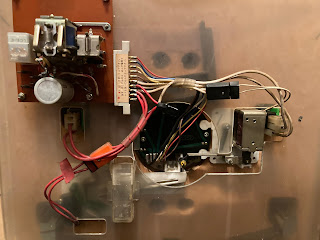
Payout unit and power module


The monitor has a bit of burn in but it's not too bad considering the age and previous heavy use.


I gave the cabinet a light vacuuming, checked all the connections and fuses, double checked I had all the tokens out and plugged it in my variable transformer adjusted at 100V. It turned on like it should and went into attract mode.


I made a short video of the attract mode and uploaded it to Youtube as a reference since no one had before.


I coined up the game, shot some balls and pressed some buttons. None of the tile buttons were registering. It was at that point I realised I had no clue what I was doing. I can't read japanese and I don't know how to play mahjong!


The balls that came with the machine were absolutely gross, which is a surprise considering they don't even get handled by the player. I changed the balls for clean smooth unmarked balls. The machine uses only 18 balls.


The 14 balls on the right side are released simultaneously at the start of the game to make the pile. The 4 balls on the left are doled out one at a time once you discard tile. The played balls return immediately to the accumulator trail after passing through one of the tile ball microswitches.


The ball trails were very dirty... to the point balls would stay stuck. They required a bit of cleaning and polishing.


Two push on / push off buttons inside the door top right.  Top one is to recall the last game played and the bottom one is for bookkeeping details (coins in - coins out = net total sice machine was last turned on).


The mysterious "tile button" not working:

Turns out that was the major problem with the game. None of the tile buttons worked. All the tile buttons, that are used to discard or to lock a group of 4 tiles were unresponsive.


I took the tile button sub assembly apart and discovered that the conductive rubber pads inside the buttons were contaminated by some type of oil, making the rubber non conductive. I tried cleaning the rubber pads with various solutions to no avail. I tried lightly sanding the rubber, but that didn't work either. I looked it up and apparently that's a common problem with some vintage computer keyboards. There's no solution for contaminated rubbers other than changing them out for good ones. Since that's not an option in my case, my only option was bodgery.


I weighed my bodgery options and opted for aluminium foil. Tiny folded strips of aluminium foil... for all 27 buttons. I actually felt dirty doing this type of bodgery. This is below my usual repair standards. But it's simple, cheap and reversible. Otherwise I'm stuck with a unplayable game.

If in the near future a button fails again, the subsequent fix will be easy. I will have to make do with this "repair" until I can find a good button sub assembly (good luck with that). 

I know I can buy conductive rubber material from various suppliers and cut tiny pieces but that wouldn't work with my situation since the rubber pad have a kind of nipple in the center that acts as a spring for the button plunger. That and the way the material is secured in the pusher.


I reassembled the assembly, tested it and it works great. For how many cycles? Who knows! But the machine will get light use anyway.


The non registering tile ball microswitches:

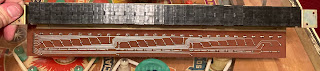
I took out the microswitch subassembly. Each switch can easily be taken out for service. I had two bad switches. I had to take the microswitches apart for cleaning and adjustment.


That sums up the work on the Satomi Sparrow Ball TV JanQ
  

General impressions:

I like this game. The look is dated, but in a good way. The cell art is a mix between greco-roman kitch and a trucker's girl silhouette. The green CRT's warm glow reminds me of my childhood. The game has an imposing amount of buttons but it's pretty simple once you know how to play the game.

Playing impressions:

Since fixing the game, I learned the basics of japanese mahjong. I enjoy playing the game. It's like playing an arrangeball, but with more control. First shoot 14 balls. Then discard a tile to shoot a ball, repeat. You build your hand, modifying your strategy as the balls land try to get a winning combination within 10 shots. Each game is pretty long, over a minute, for one token. That's good entertainment value for the money. There's a few scoring subtleties specific to the TV JanQ (not mahjong in general) that still elude me but I don't mind.

My first win!


More wins in that glorious green glow


Reference pictures


Satomi TV JanQ 雀球 sparrow ball game PART I

It started with a fascination about a type of game I didn't even know the name of... Sparrow Ball, basically it's a mix between pachinko, (maybe more like and arrangeball) and the game of japanese mahjong.

For the history of Sparrow Ball here is a Japanese Wikipedia article. Just translate to english and enjoy.

The short short history:

First game in 1958... first TV game in 1979.

Sparrow Ball parlours phased out in 2007 and completely gone by 2013.


One day, while perusing Yahoo Japan Auctions, a Satomi TV JanQ sparrow ball popped up for sale. I had to buy it.

The Google translated YJA auction description mentioned the "tile button" and sound not working, but overall the game worked.

Shouldn't be too hard to get it working I thought.

There was even a video of the actual game in action. The screen brightness is obviously adjusted too high and a few tiles didn't register. No Biggie.


Buying a machine off YJA is always a gamble. The pictures are usually bad. The description, minimalistic and the details... foggy.

Furthermore, you have to use a Proxy bidding service. Once you win the machine, you're committed, all the way.

You pay for the bidding service, reception, re-packaging (if necessary) and expedition (not cheap).

To that you add duty and customs brokerage fees plus any other fees the intermediate parties decide you have to pay.

Basically, once you win the auction, you strap your wallet to a rocket and blast off! So it better be worth it.

The Satomi TV Jan-Q arrived 6 days later in a gigantic 49 kg box. As the delivery guy carried the box from his truck to my doorstep I could hear the tokens and balls sloshing around inside the cabinet. Finally I could see what I bought.


Continued in part II

Friday, December 17, 2021

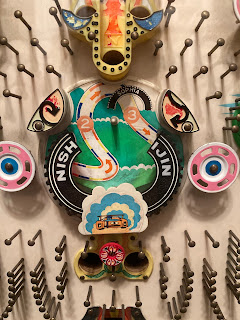
December 1974 Nishijin Circuit Racer: Early production game?

 As mentioned in the previous post, I acquired a Nishijin Circuit Racer.

Nishijin Circuit Racer

Soon after, a friend mentioned that I could buy replacement stickers for it. But when I compared my machine with the sticker set, mine were slightly different. The car sticker in the "cloud" is different and my the feature artwork doesn't have the fork in the road around the "4" and "G", nor does it have the second "S" at the start. Fortunately, my stickers are still in decent condition.


And contrary to other descriptions of circuit racer that are found online, the left and right yellow trophy holes start the feature, not the center hole. Center hole opens only the bottom centre tulip on mine.

The funny thing is that when the tire feature is open, you can't see the S, 4 and G lights. Should have used a low profile tire instead ;-)


You can see the S, 4 and G lights only if you look from the side.


Circuit racer is known to be a game from early 1975, so the expiry date stickers would indicate some months in 1976 (S51). But my expiry sticker indicates 50-12 (December 1975), meaning it was released some time in December 1974. Does this mean I have an early production game?


Pachinko Palace imported some rare gem!


Here is a very informative article about pachinko machine expiration dates. I used the article as a reference for my tiny bit of research.

Thursday, December 16, 2021

Nishijin Circuit Racer


By chance, I picked up a rare Nishijin Circuit Racer pachinko machine. It's one of the few models of that era that utilizes an electromechanical feature. Most pachinko machines from that era are purely mechanical devices except for a couple of lights and leaf switches.


Nishijin Circuit Racer


When I first got the machine it was dirty, the back was falling off and the tire feature coil was continuously energized with no power going to the lamps. The cleaning and falling back were an easy fix not worth documenting. The stepper unit required partial dismantling to access the wiper and disc for cleaning.

The feature unit is very nice with a sealed relay, a tiny wiper and disc, a step up coil, a reset coil and a delay circuit for the reset coil. The board also has 4 diodes as a bridge rectifier.


Here's how the unit works.

Under normal conditions, when the feature is not engaged. The stepper unit wiper is in zero position and the sealed relay is energized breaking the circuit to the tire solenoid.

When a ball triggers the feature micro switch it momentarily energizes the step up coil, shifting the wiper one position. The small sealed relay drops out and it's switch makes the circuit for the tire solenoid.

Additional balls in the feature steps up the unit via the micro switch until it reaches last step.

The stepper unit reset coil is energized by the last step on the stepper unit or by the left or right pit stop micro switches. 

Wiper winds back to zero position, small relay is energized by zero position and tire feature solenoid drops out.

Stepper disc steps:

0 - Energizes sealed relay

1 - S light

2 - 2 light

3 - 3 light

4 - 4 light

5 - G light

6 - Energizes stepper reset coil 

Enjoy some reference pictures of the stepper unit. Details are few for this game!


Tuesday, November 2, 2021

Derby Triple 300 Showa era medal game

Presenting... another obscure horse racing themed game: Derby Triple 300


The Manufacturer and the year of production are unknown to me but I suspect it's from the early 70's.

One of my main collecting interests is electromechanical gambling machines. Earlier this year I became interested in Japanese gambling machines. I started perusing Yahoo Japan Auctions and stumbled upon an auction listing for a machine called New Mini Derby.


But more importantly, I became intrigued the the machines inner workings.


From the outside the machine looked alot like what was offered in Great Britain at the time but the inner workings are way more intricate.


The auction price for the New Mini Derby was a bit too much for me and I passed on it but soon after I found a listing for Derby Triple 300 so I purchased it off YJA.


I bought the game almost unseen. The machine was listed as Junk, but working. Locked with no key and there were no pictures to attest that the games was complete. I took a chance. The game was very similar to the New Mini Derby and I suspect it was produced by the same manufacturer. I presumed it was electromechanical because the play features were relatively simple.

It arrived in a very large box delivered by courier.


When I got the machine unpacked it was indeed locked, but with a bit of gentle prying, I got the game opened, and was happy to see it was complete except for the missing coin box. Its electromechanical alright... with 50 relays!

The box was obviously knocked about in transit and a few parts were out of place, Notably the payout tubes and a few printed circuit boards.


I also found a bit of treasure inside: One 1 Yen coin, one 5 Yen coin, one 100 Yen coin, 4 10 Yen coins and 20-ish Bally 10 Yen coin sized tokens. Score!


I gave the machine a good visual inspection. Put all the loose parts back in their place. Made sure there were no broken parts and that nothing (like a loose coin) might cause a short circuit.

Looked at the electrical nameplate. Despite the operation voltage indicated at 125V I had my doubts and ran the game off a variable transformer adjusted to 100V since the game is a Japanese domestic unit.


Inspected the Transformer, bridge rectifier and fuses that were hidden behind a panel. Notice the multiple taps off the secondary, probably to compensate for line voltage.


Once I ascertained the machine was electrically sound, I plugged it in and the game lit up.


I then flicked the coin switch and started a game. It didn't function very well but I could see the game had potential.

For repairs, I started by burnishing the pads on the printed circuit boards and I cleaned the wipers. There was a patina of oxidation on pretty much everything. 


There are 5 similar boards, each with a low RPM motor and a wiper. I don't have any technical details, but I suspect one is for the game sequence, one is for payout impulse, one is for flasher animation, one is for random odds and one is for random selection. None of the relays are labeled and I haven't taken the time yet to figure out what each one does.

The game is well built with quality connectors. All the Relays are Omron sealed relays mounted on socket bases. The lamps used are 30V ba9s base and replacements can be easily found.

The machine has a basic attract mode where two lamps behind the panel "Derby Triple 300" flash alternately by way of a simple flasher circuit when the game stands unused. The flasher is interrupted when the machines is coined up and resumes after a spin cycle.


The machine uses an adjustable coin rejector and I adjusted it to .984 standard pachislo tokens.


The coin slot has a coin lockout coil. 


The buttons used are high quality industrial grade buttons.


It has a basic sound circuit and speaker that approximates the sound of running horses during a spin cycle. The volume potentiometer was bad and needed replacement. There is another small potentiometer for the "galloping speed" adjustment.


There are 2 payout tubes and the payout solenoids deal the coins in stacks of 5. The payout slide mechanisms needed a but of degreasing and a fresh re-lubrication.


Hidden behind the coin tubes there are three small stepper units that I suspect are for some mixer circuit and 4 toggle switches that are probably for payout percentages. The steppers advance one step each spin cycle.

Sadly, not having any instruction or schematics, I may never know their purpose for sure.


SO HOW DO YOU PLAY IT?

First insert a coin. Coin lockout solenoid then energises stopping you from inserting additional coins until a selection is made.

Yellow arrows light up to indicate selection choices. Press button under number 1 to 6 to select.


Once a selection in made additional coins may be deposited for more selections or to multiply potential payout of any selection so that each selection may have up to 3 coins wagered. With 6 selections thats a potential of 18 coins per play.


Once selections are made, press large button to start the spin cycle.


Spin section has two parts. One is to determine the payout (10, 20, 30 or JP (Jackpot is 100)) 


The other is to determine winning selection. The spin cycle can land on any if the 18 panels. Not just panels 1 to 6.


If the end of the spin cycle lands on a lit selection, you win. Maximum possible is 300 tokens. "Payout" panel is lit during payout cycle.


If you have any additional information or historical context about these early Japanese medal games please leave a comment.