Monday, September 12, 2022

Keeney Mountain Climber (1967) Revisited and repaired

Keeney's Mountain Climber 1967 Upright Flasher Slot Machine.


OG followers of my blog might remember I got this machine back in 2016.

2016: Seems like a long time ago... I had more hair (but it was shorter), more faith in humanity and less machines.

I got the game in the first place because of the IEE (pronounced "I double E") Panasocpe displays. Since then it mostly sat in the "storage" part of my basement.


Weird view of the panascope displays


Recently I was bored without a project so I decided to take the game out of storage and get it working properly.

I tried to recall my 2016 mindset that rationalised it was better to just stick the game in storage and forget about it rather than fix it. I think it came down to too many projects on the go, the general condition of the machine and the fact I had way less parts on hand. Back then I thought it wasn't worth the parts "investment". Now, it's different, I can literally pick up parts off the floor of my shop. The place is a mess of parts.


To misquote Raoul Duke: 

There was evidence in this room of excessive consumption repairs of almost every type of drug coin operated device known to civilized man since 1544 AD 1936.


What are Mountain Climber's features?

  • The cabinet's design makes it a superb beverage shelf.


  • It has panascope displays
  • It has a hold feature for each symbol window. What the machine calls "Skill Stop" but not in the same way as modern-ish pachislo games have a skill stop.
  • Arrows are wild. That means arrows can replace any other symbol to make a winning combination.

Arrow Bell Arrow registers as 3 Bells


  • It has a double or nothing gamble feature with the mountain climber... I guess you could call it an animation of the climber' perilous ascension to the summit.
Once the player gets a winning combination, the machine prompts the player to choose either to take the score or play for double or nothing, then again for double-double and double-double-double. That's potentially 8 times the payout of the original win... or nothing.


Once the double or nothing button is pressed, the back lighting of the panels cycles from left to right and back until it ultimately stops on a panel determining if you got double or nothing.


Each double win advances the back lighting of the plateau payout column. First plateau is Regular win. Fourth plateau is a double-double-double win

Here's a clip *not my video* of the double or nothing feature from Keeney's Mountain Climber from SLOTS 'R FUN CASINO

Features continued...
  • 3 melons or 3 arrows or a combination of melons and arrows pays out as bonus tokens (Gold Award Payout). Originally those combinations would pay out from a separate payout unit one or more special tokens each worth 100 credits to be redeemed by an attendant. Cool feature but it was removed on my game.😠 
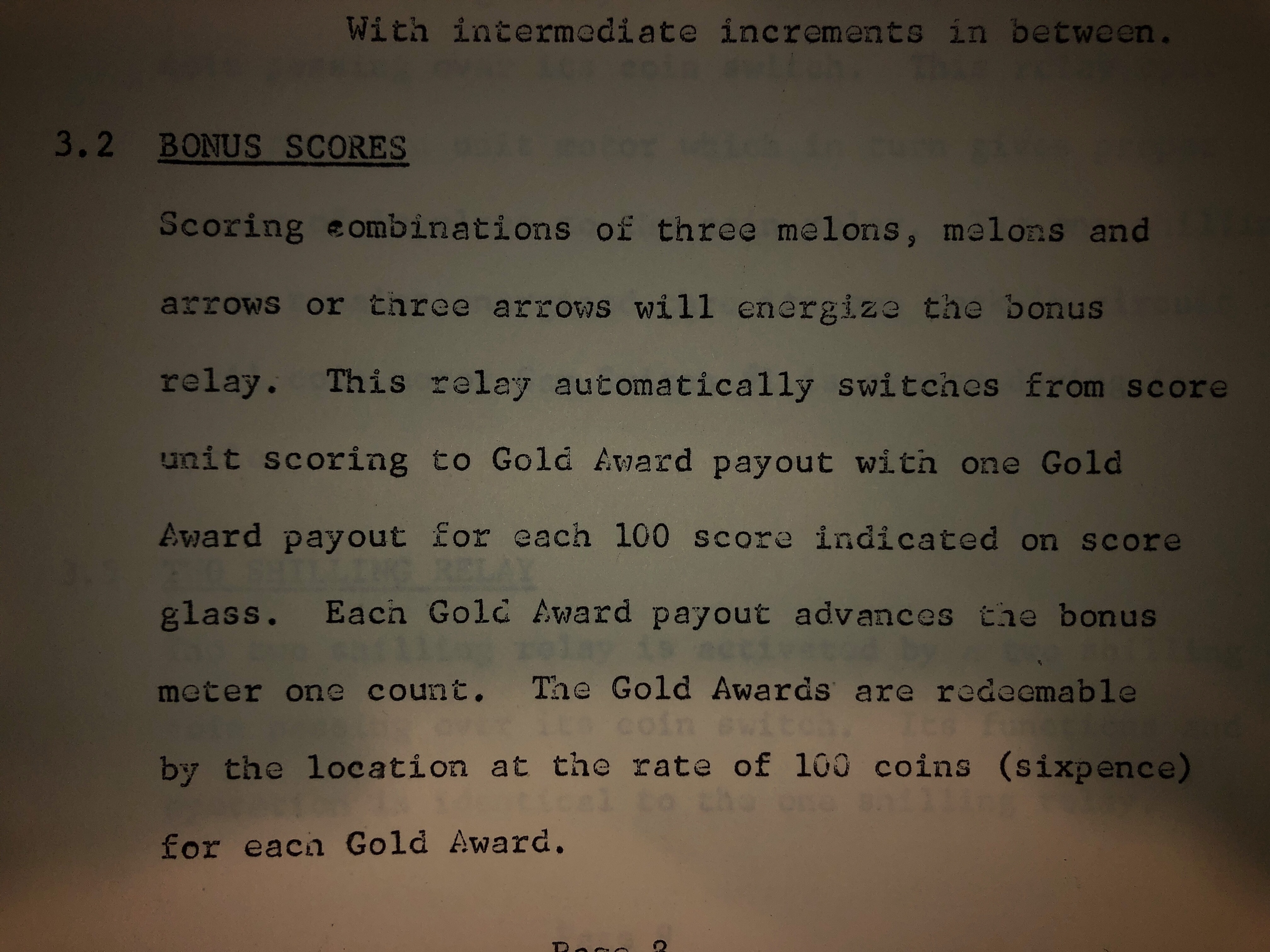
Gold award payout details from the manual

As it is in my machine, the melons / arrow combinations just lite a "BONUS" panel on the glass in the mountain chalet once collect score button is pressed. Future project for this machine might be to find a substitute for the gold award payout solenoid.

Back in the day in a Quebec tavern the way it was operated you would get the attendant's attention in the bar and they would pay you directly (that's my best guess).


  • Inside the coinbox compartment there's 3 meters and an adjustment knob to make the game more or less generous.


Meters: Cash payout, Coin and Total Gold Award

Knob and dial for Liberal / Conservative adjustment 


Adjustment details from the manual


So what's wrong with my Mountain Climber?

  • The cabinet is a mess and is currently, and has been for the last 5 years, resting on a movers dolly.


  • The double or nothing feature unit was damaged.


  • It's a european market re-import, still with the british pre-decimal sized coin chute. Not a problem but the game is well travelled. 


  • It has the wrong handle... from a Bally flasher.


  • The glass is roached.


  • The Panascope displays are faded.
  • Someone added a credit button for previous home use. That's OK. It works, I'll keep it that way.
  • The machine was "converted" for the Quebec gambling machine laws of the time:
That is the payout hopper and the bonus payout solenoid were removed. Furthermore, the wiring was altered so that the replay register resets back to zero by way of the impulse unit when the machine is turned off and then back on to knock off the credits. Despite being modified, I have to presume the game was funcional at some point before being decommissioned. 


The repairs:

I remember back in 2016 cleaning most of the relay switch points, cleaning the flasher discs and unjamming the clutch washers, changing the lamps on the IEE displays, then I remember it played like crap and just put it away.

Looking at the game now with eyes 6 years older and some experience acquired along the way... this is what I found was wrong with the machine:

Erratic credit unit: The credit unit is from a Bally machine (but that's not a problem): However, the credit unit step up coil was weak, causing the credit wheels to go up and down erratically when adding up a win. Furthermore the points on the score impulse relay that pulses the step up coil were excessively pitted and had to be filed down.


The double or nothing feature registered intermittently: You would land on double and it would register nothing every once in a while. 

That was caused by the wiper disc on the double or nothing unit being no longer centered with the wiper assembly due to the trauma the unit sustained at some point. That caused the wipers to not being able to touch the contacts they were meant to about 180 degrees out of 360.

That unit sustained a good hit judging by the damage


The wiper motor shaft, the wiper unit and the wiper disc are all supposed to be precisely centered relative to each other.

To fix I bent two of the 3 still usable posts spacing the disc with a beefy pair of pliers, checked it and gave it a "good enough". All the contacts and wiper arms touching when they're supposed to.

I know the 2016 me would have cringed at using brute force like that from fear of making it worse but the way I look it now, the unit was already screwed as it was, might as well try to wing it.


Incorrect scoring or no scoring at at: Took apart the step up and reset arms for both the plateau unit and the commutator unit. Cleaned and lubed the moving parts. Both units were excessively gummed up and both needed a new coil stop and plunger spring for the reset coil. Mid 50's Bally stepper unit coil stops were a perfect fit. Also, part of the step up arms were bent out of shape from excessive actuation causing the units not to reset properly at the start of a new "spin cycle" after collecting a win. Again, bent the parts back into shape. 

Gross looking unit needs a good cleaning.


3 Oranges would score 9 instead of 10: That's a weird one... a segment of wire to the last contact for the 10 win was intentionally cut by some d.p.o. on the back of the commutator unit disc. Easy fix with a tiny bit of wire and a gob of solder.

Each win has it series of contacts


Gameplay Impressions:

I have to say I like this game. I didn't think much of it at first but Mountain Climber is very entertaining to play.

There's a lot of interaction between the player and the game, compared to Super Wild Cat and Little Buckaroo.

The hold feature is fun and engaging and the double or nothing all the way to double double double adds extra zest and danger to the gameplay experience.

It has a bell with the most charming chime that rings every time you get a winning combination or successfully gamble the double or nothing feature.


One funny thing is how the melons on the payout scale dont look like the Panascope symbol. Actually none of the panascope symbols (except for the bell and lemons) look like the ones on the glass. Like they were created by two separate art departments that didn't talk to each other.




A bit more reading and viewing

A 2016 post I wrote about fixing my first Upright: Keeney Little Buckaroo

An old school webpage about Games, Inc. "The Hunter": http://rwatts.cdyn.com/Machines/Hunter.html


Saturday, September 3, 2022

Super Wild Cat by GAMES INC. 1960 Upright Flasher repairs

 Super Wild Cat by Games INC. 1960 Upright Flasher


In the previous post,  you may have seen a video of the Super Wild Cat in action. Here's the promised background information about the game.

Why did I get this game? Because...  

I like slot machines, but not all slot machines. I don't give a crap about pure mechanical slot machines, no matter how elegant they are and I don't give a crap about electronic slot machines.

That leaves the electromechanical slot machines. From electric consoles to the Money Honey and all it's variations basically.  Why do I like electromechanical slot machines: Bueschel summarised it beautifully...

Richard Bueschel wrote:

"The Arrival of the uprights and their circuitry-based play features brought something to slot machine play that had not been there before: multiple coin, double-up, hold-and-draw, multiplier, multiple line payoffs and other advanced features were exciting play generating ideas that the mechanical slot machines of the past could never hope to handle."

More specifically, I like upright flasher slot machines. Flasher slot machines only exist because of a definition of what was a slot machine in the Johnson Act:

(1) any so-called "slot machine" or any other machine or mechanical device an essential part of which is a drum or reel with insignia thereon, and (A) which when operated may deliver, as the result of the application of an element of chance, any money or property, or (B) by the operation of which a person may become entitled to receive, as a result of the application of an element of chance, any money or property...


So what did the coin-op engineers do: they created slot machines with no reels.

It was some sort of cat and mouse game between the LAW and ingenuity that lasted a few years and that gave rise to a bunch of interesting electromechanical games along the way.

I got the Super Wild Cat about a year ago from my "favorite" coin operated amusement equipment reseller in ville Saint-Laurent (Montreal). Here's another game that sat in their warehouse for years.

The business owner kept the game as a keepsake from the good old days in New Brunswick where the game was operated for a number of years. Apparently Super Wild Cat was a great money maker. Over the years I was offered the game a number of times but the price was exorbitant. In the end they were cleaning out the warehouse and I got the game for the right price along with a Midway SAMI.


The fit was tight in the Sienna. The purchase of SWC was unplanned.


I dropped the game off at my Freundin's house and forgot about it for about a year. I just didn't feel like working on it.


The repairs

I eventually got around to working on Super Wild Cat.

All the electromechanical bits are on a insert that can be removed for service, making it easier to work on.


First thing I did was check all the relays and switch points. I look for broken switch blades, pitted points, broken wires, missing insulators on the stack. I manually actuate the switches and make sure the switches open and close properly. I clean all the switch points and check the switch stack screws to make sure they are nice and tight.


Then I clean all the stepper units. Clean off the old congealed grease. Clean the solenoid plungers, change worn out coil stops. Clean the contact dics and wipers. lightly lube the metal on metal pivot points and check the step-up and reset arm for smooth actuation. Making sure the unit can step up all the way and swiftly resets back to zero.

Then I cleaned the flasher units. I had to completely take the units apart to clean and relube the leather clutch washers.


Then I reassembled everything, played a few games, and discovered that the flasher units did not index properly. That's because of excessive gameplay: After years of continuous use the edges of the index cams had mushroomed over narrowing the gap of the slots. The index arm would not index in a number of slots. I had to take the flasher units apart again and go over every cam and give it a quick zip with a small file. Nothing excessive, just a little kiss with the file.


Gameplay impressions:

There's not much to say on gameplay impressions. It's a 4 "reel" slot machine with no holds. Pretty basic.

The super WILD Cat is for the fact that the Wild Cat is a "wild symbol", meaning it can replace any other symbol to make a winning combination. That's why it has all the other animal symbols around the cat. That's why the ad claims 115 ways to score.


Ad for Super Wild Cat from the February 8th 1960 issue of Billboard. Page 76


You might be here looking only for the value of one of these games? Basically these games have no value. They frequently dont sell at auction. One or Two hundred Canuckistan dollars max. depending on condition.


Old School webpage about Games INC.


Monday, August 15, 2022

Sunday, July 3, 2022

Midway S.A.M.I. Arcade intermittent problem repair

I've owned this 1970 Midway S.A.M.I. arcade game for about a year now.


When I first got it I went over the whole game. Cleaned the discs and wipers. Took apart the control unit. Burnished the connectors and perfectly aligned the film with the plane position disc.

Still it had an intermittent problem that would cause the hit relay not to energize.

I would fiddle with the connectors and jiggle the wires, check the continuity between the control unit disc and the plane position disc and the issue would solve itself for a couple months.

I can't say I play this game a lot. It's not a good game to have in a home environment. The plane pattern is too easy to memorize and then there's no challenge to the game. But I like to play it occasionally. Or like when I have some people over.  So when I turn on the game, it's always a gamble whether the game behaves or not.

So when I turned the game ON earlier this week... no dice. Again the multimeter and connector jiggle routine. But this time I finally stumbled upon the problem.

Can you see the problem in the picture below? BTW I slightly enhanced the problem to make it easier to find.


Maybe in this picture?


Turns out the problem the whole time was a broken bare wire jumper for the grey wire between solder lugs on the Hit Relay unit.

The intermittent nature of the problem came from the broken jumper just touching the gob of solder on the lug for the hit relay coil hence why jiggling the wire would "fix it" for awhile.

On the schematic, the problem would be in the red box to put it into perspective.


I completely replaced the bare wire jumper and now it's all good.

This is the kind of stuff you have to look for when working on old arcade games.


Wednesday, June 15, 2022

Nishijin Lucky Welcom arrangeball bonus feature

As promised, here is a short explanation of the bonus feature of the Nishijin Lucky Welcome arrangeball.

The bonus feature is located at the top of the playfield and starts when the first winning combination is achieved on the main card. You only get one bonus feature per game.

The bonus feature consists of 8 panels that are lit in sequence rapidly, like a really fast light chaser that goes from left to right.


The player presses the bonus feature button on the left of the cabinet to stop the feature on one of the panels. It's a kind of skill stop feature. 


Once pressed the feature animation will stop on one of the 8 panels that will stay lit for a few seconds.

There are four green panels that pay out 1 token automatically. 


That's on top the standard payout from the main card, just to be clear.

There are 4 panels that will prompt a second spin cycle localized within that one panel.

Those panels are divided into 3 different coloured sections. There is a light animation that spins clockwise during the second spin cycle. Pressing the feature button will skill stop the animation on one of the panel's section.

This panel will  pay out 1 token OR 2 tokens OR 1 token.


There are 3 panels that will spot numbers on the main card as a result of the secondary spin cycle.

By "spot" I mean that the number is lit on the main card, without having to land a ball.

Of course, these spotted number count for winning combinations on the main card and stay lit for the remainder of the game.


This panel spots 5 OR 8 and 12 OR 9 


This panel spots 1 and 6 OR 1, 4, 13 and 16 OR 7 and 11

This panel spots 2 OR 14 and 15 OR 3
  
Here is a short video of the bonus feature with only 1 skill stop landing on payout 1 token.


Here is another short video with the first and second spin cycle ultimately landing on payout 2 tokens.


Monday, June 13, 2022

Walkthrough of Japanese warehouse of vintage pachinko and pachislo

I want to share this awesome walkthrough video of a warehouse full of vintage pachinko and pachislo machines in Japan. My favorite part is 5:45 to 10:50. *Not my video*

Also check out the channel ã‚¹ãƒ­ã‚¢ãƒ•ロ. Really cool videos with alot of 80's and 90's gameplay content.


スロアフロ 


Enjoy!

Tuesday, June 7, 2022

Nishijin Arrangeball: small repairs and flattening warped plastic in the oven

Nishijin Lucky Welcome Arrangeball Repairs

First things first: When working on Japanese domestics products, use JIS screwdrivers to avoid stripping the screws. Here's the set I use on my games.


I guess a good starting point for the repairs is the auction item description:

Translation from YJA

First issue: "there were places where the ball did not light up"

That was a funny one. The first time I played the game, I noticed the wrong number would light up on the card. Example: I'd hit a 11 and 6 would light up or hit 2 and 14 would light up.

At first I thought the connector for the card light PCB might have been plugged backwards, the wiring loom did have an unnatural kink going to the board, but I noticed the connector was keyed when I pulled it, so that wasn't the problem. Turns out it was just the whole card lamp board was installed upside down. As can be seen in the auction picture below.


Picture from YJA

Light board right side up


Second issue: "Pachinko balls can be hit endlessly."

That one was a lever to the ball release coil that was intentionally pulled by repositioning the return spring,  jamming the ball release gate in the open position, so that the balls would continuously circulate to the shooter. Flipped the lever back in it's intended position and bingo.

Ball release fixed

The MAJOR problem with this game was the card that was melted into an unsightly mess. It didn't affect gameplay but it looked awful. 
 
I guess that at some point the card number bulbs were replaced with lamps that ran too hot when lit and the game stayed on too long. The card warped and sagged from the heat.

I decided to try flattening the card using my kitchen oven. But first I had to remove the card.

To remove the card, first I had to remove the card lamp board.

With the lamp board out (again) I replaced all the lamps with new 2187 bulbs that run way cooler.

Then I removed the card besel and the pegs that held the card to the shroud. To remove the 4 chromed pegs in the centre of the card. First I had to remove nuts in the back of the shroud, then I had to gently persuade the pegs out with a pair of miniature vise-grips. To avoid damaging the chrome I put some duct tape on the jaws of the pliers. Pro tip ;) 


Here's what the front of the game looks like with the bezel and card removed.


Once the card removed I took a few detailed pictures just in case I totally mess up and had to get the card reproduced somehow.

This picture really doesn't show just how badly the card was warped. It was the elephant man of arrangeball cards 

As can bee seen from the back of the shroud, the bulbs ran way too hot!


Here's a pinside thread about flattening pinball plastics.

I used that information as a starting point for my experiment.

The trick is to soften the plastic by heating it up, close to the melting point but below the boiling point (That's when you get bubbles in the plastic).

What people fail to consider is that regular ovens suck at controlling temperature. The dial is vague at best and the heat control is awful. The temperature oscillates +20 and -20 degrees celcius from the set point in my oven.

For better control and temperature reading, I used my multimeter that came with a thermocouple

I found two pieces of thick plate glass in my supplies and sandwiched the card in between, then put it in the oven at a low (safe) temperature.

Getting the oven warmed up:

No, I didn't heat the plastic directly on the rage element. I was just illustrating getting ready


The thermocouple supplied with my multimeter.

I slowly and gradually turned up the heat in the oven and continuously monitored the temperature and state of the card. The plastic became soft at a temperature between 110 and 120 degrees Celsius (that's 230 to 250 in Freedom degrees). The card flattened out just with the weight of the glass.

The end result isn't great but at least the card is is flat now. Looks way better. I'm satisfied the result considering the state of the card.


To wrap up this post here's a couple teaser videos of the bonus feature in action.